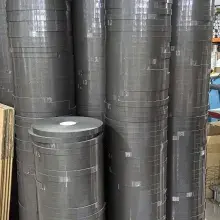
Adhesive foam is cross-linked polyethylene foam coated with a pressure-sensitive adhesive on one or both faces, supplied on a release liner as a tape or a die-cut part. Bofeng Foam manufactures adhesive foam in Zhuhai, China, coating the foam in house so the adhesive, the foam grade and the cut profile are specified together.
Foam tape does two jobs at once in most assemblies. It bonds the part in place, and it keeps doing the job the foam was chosen for — absorbing shock, sealing a joint, damping vibration or insulating a surface — while the adhesive holds it there.
What is adhesive foam?
A foam tape is only as good as the weakest of three interfaces: the adhesive to the foam, the foam itself, and the adhesive to the substrate. Coating in house means the first of those is under our control. The middle one is where the material choice matters — a foam that is too soft will deform under the peel load and let the bond creep, while a foam that is too firm will not wet out an uneven surface.
The third interface is decided by the user, and it is where most bonding failures actually happen. Adhesive bond strength depends heavily on surface energy and cleanliness. A smooth, clean, high-energy surface such as bare metal or glass bonds readily; a dusty, oily or low-energy plastic surface needs preparation or a different adhesive formulation.
- Adhesive coated in house — one supplier for the foam, the adhesive and the cut profile, so accountability for a bond failure sits in one place.
- One or both faces — single-sided for laminating to a panel, double-sided for bonding two parts together.
- Release liner — supplied on a liner for clean handling and positioning during assembly.
- Cut to shape — die-cut and CNC-contoured parts, not only rolls and strips.
- Foam choice preserved — the adhesive is applied to the grade the application needs, so you do not lose the sealing, cushioning or damping function to get the bond.
Foam materials used for adhesive foam
The foam under the adhesive is still chosen for the job it does in the assembly — the adhesive just holds it there.
- XPE foam — chemically cross-linked polyethylene foam. Closed-cell, produced at 3–40× expansion with a density range of 26.8–300 kg/m³, in single layers of 3–15 mm. The general-purpose grade for most industrial work. View XPE foam →
- IXPE foam — radiation (electron-beam) cross-linked polyethylene foam. The finer cell structure allows single layers down to 0.1 mm with a smoother, more uniform surface. View IXPE foam →
- IXPP foam — radiation cross-linked polypropylene foam. Stiffer and more heat resistant than PE foam, with a maximum service temperature up to 140 °C. View IXPP foam →
| Material | Cross-linking | Expansion ratio | Width | Single-layer thickness | Heat-bonded multi-layer |
|---|---|---|---|---|---|
| XPE foam | Chemical (peroxide) | 3–40× | 500–2000 mm | 3–15 mm | 15–200 mm |
| IXPE foam | Radiation (electron beam) | 3–40× | 500–2000 mm | 0.1–15 mm | 15–200 mm |
| IXPP foam | Radiation (electron beam) | 5–25× | 500–1500 mm | 1–6 mm | 6–100 mm |
XPE gives the most economical general-purpose tape for bonding, mounting and gap filling. IXPE is the grade for thin, dimensionally precise tape where the bond line has to be a fraction of a millimetre. IXPP is chosen when the bonded part also has to survive heat.
Specifying a foam tape
Five questions decide the specification, and the answers come from the assembly rather than from the foam.
- Substrate — what is being bonded to what. Metal, glass and many rigid plastics bond readily; polypropylene, polyethylene and powder-coated or oily surfaces need preparation or a different adhesive.
- Load direction — foam tape performs best in shear and poorly in peel. If the joint will be pulled away at an edge, design the part so the load is carried in shear.
- Thickness — thicker foam tolerates a rougher or less flat substrate because it can conform; thinner foam gives a tighter, more dimensionally stable bond line.
- Environment — temperature, UV and moisture all affect the adhesive as well as the foam; the heat-resistant and IXPP grades are available where the bond line runs warm.
- Assembly method — a liner and a die-cut shape make a manual operation repeatable, which is often worth more than extra bond strength.
For foam bonded to a facing rather than to a substrate — foil, non-woven, leather or flannelette — see our lamination methods guide and the laminated foam page.
Adhesive foam products we manufacture
- Industrial tape foam — general-purpose foam tape for bonding and mounting
- Automotive tape foam — trim and badge attachment tape for vehicles
- PV tape foam — foam tape for photovoltaic module assembly
- Medical tape foam — foam carriers for medical adhesive products
- Laminated foam — foam bonded to foil, non-woven, leather or flannelette
- Foam gasket — adhesive-backed sealing gaskets
Typical applications
- Trim, badge and panel attachment
- Mounting and gap filling in appliance assembly
- Sealing and bonding in HVAC and ducting
- Photovoltaic module assembly
- Medical and wound-care adhesive products
- Vibration damping pads bonded to equipment
Why choose Bofeng Foam?
Bofeng Foam is a direct factory manufacturer of cross-linked polyethylene foam in Zhuhai, China, with more than 10 years of experience in the foam industry. We run both chemical and radiation cross-linking in house, which means the material grade, density and surface finish can all be matched to your application rather than picked from a fixed catalogue.
- Both cross-linking routes in house — chemical (XPE) and electron-beam radiation (IXPE, IXPP), so you are not pushed towards one material for supply reasons.
- Wide grade coverage — expansion ratios from 3× to 40× and densities from 26.8 to 300 kg/m³, with single-layer thickness from 0.1 mm and heat-bonded multi-layer stock up to 200 mm.
- Converting under the same roof — die-cutting, CNC contouring, lamination, adhesive coating and slitting, so a finished part arrives instead of a roll.
- Functional grades when the application demands it — flame retardant (limiting oxygen index 27, meeting GB 8410 A0 and UL94 V2 requirements), heat resistant (110 °C, shrinkage ≤8%) and conductive (10³–10⁶ Ω) or anti-static (10⁶–10⁹ Ω).
- Engineering-led specification — send a drawing or a sample and our team will recommend the material, density, thickness and surface treatment that fit the load case, then confirm it against the GB/T test standards published on our material pages.
Request a quote for adhesive foam →
Send us the two surfaces being bonded and the environment the joint will see, and we will come back with a foam grade, a thickness and an adhesive format. Where the assembly is manual, we can also supply the part die-cut on a liner so the operator positions one piece instead of cutting tape to length.
Adhesive foam FAQ
What is the difference between single-sided and double-sided foam tape?
Single-sided tape has adhesive on one face and bonds the foam to a surface — used for gaskets, bumpers and protective pads where the foam itself is the functional layer. Double-sided tape has adhesive on both faces and bonds two parts together through the foam, which is the format used for trim, badges and panel attachment.
Why does foam tape fail on some plastics?
Because of surface energy. Adhesives wet out and grip a high-energy surface such as bare metal or glass, but polypropylene, polyethylene and some powder-coated or moulded surfaces are low-energy and the adhesive cannot form a proper bond. Cleaning, abrading or priming the surface usually resolves it; on stubborn substrates a different adhesive formulation may be needed. Tell us the material and we will recommend the right combination.
How thick should the foam be in a tape?
Thicker foam conforms to a rougher or less flat substrate and absorbs more movement, which is why mounting tapes are often 1 mm and above. Thinner foam gives a tighter, more dimensionally stable bond line, which is what precision assemblies want. Our IXPE reaches 0.1 mm single layer when the bond line has to be minimal.
Can the adhesive foam be die-cut to a shape?
Yes. We supply adhesive foam as rolls, as strips, and as die-cut or CNC-contoured parts on a release liner. For repeat assembly work a cut part is normally better than a roll, because it removes a manual measuring and cutting step from the line.
Does foam tape hold at high temperature?
Standard foam tape is used at normal indoor and vehicle-cabin temperatures. Where the bond line runs warm, the foam grade matters as much as the adhesive: our heat-resistant grade is rated to 110 °C with shrinkage of 8% or less, and IXPP foam extends the ceiling to 140 °C.
Related reading
See also: Foam lamination: four methods · XPE vs IXPE vs IXPP foam guide · Ultra-thin IXPE foam for electronics and keyboards · How to choose foam density and thickness.