
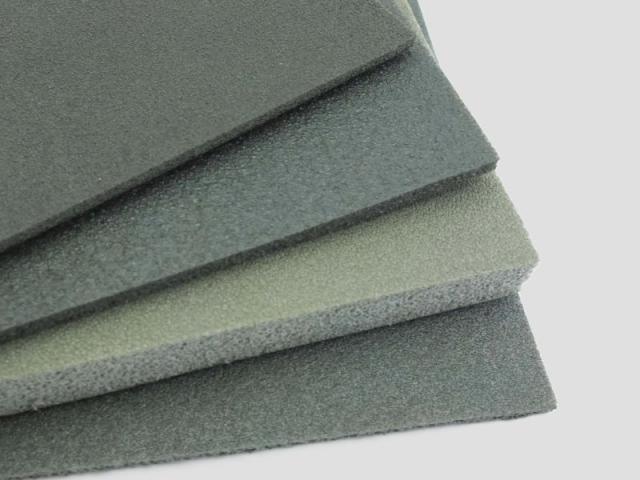
Density is the first number written on an XPE foam quotation, and the one most often written as a sentence that says nothing. “XPE foam, density 50” fixes the weight, and nothing else — not the hardness, not the tear strength, and not whether the part still springs back after being compressed. This page puts the ten grades Bofeng produces into one table, explains what each of the four numbers answers, how the ten grades fall into four bands, and the four ways a density line on a quotation stops being checkable.
The page is an index and a writing guide. How density follows from expansion ratio, and how to verify a delivery, are covered in how XPE foam is made. What the dense end buys and costs is in high-density XPE foam. The grade-by-grade comparison between XPE and IXPE at the same ratio is in XPE and IXPE compared.
Ten grades: density is ten points, not a curve
XPE foam is made from 3× to 40×, and we run ten grades: 3, 5, 8, 10, 15, 20, 25, 30, 35 and 40 times. Each grade corresponds to one apparent density, from 300±40 kg/m³ at 3× down to 26.8±3 kg/m³ at 40× — an order of magnitude between the two ends.
You cannot interpolate between them. The ratio is fixed when the material is dosed; the density is measured after expansion. There is no “12.5×” grade to order. If a design calls for 85 kg/m³, that figure sits on no row: the answer is to pick the nearest grade and state the tolerance band you will accept, not to average between 100 and 66.7.
The four columns needed for a decision, taken from the ten-grade table (GB/T 6343, 2411, 10808 and 6669). The full thirteen-row table — tensile strength, elongation at break, dimensional change and thermal conductivity — is on the XPE foam product page.
| Expansion | Apparent density (kg/m³) | Shore hardness (°) | Tear, machine (kN/m) | Tear, cross (kN/m) | Compression set |
|---|---|---|---|---|---|
| 3× | 300±40 | 65–75 | ≥12 | ≥14 | ≤2% |
| 5× | 200±30 | 60–70 | ≥12 | ≥13 | ≤2% |
| 8× | 125±15 | 50–60 | ≥9.0 | ≥9.5 | ≤3% |
| 10× | 100±10 | 45–50 | ≥6.0 | ≥6.5 | ≤5% |
| 15× | 66.7±8 | 35–45 | ≥4.5 | ≥5.0 | ≤7% |
| 20× | 50±6 | 30–35 | ≥2.5 | ≥3.0 | ≤8% |
| 25× | 40±4 | 25–30 | ≥2.0 | ≥2.5 | ≤10% |
| 30× | 33.3±3 | 18–25 | ≥1.2 | ≥1.5 | ≤10% |
| 35× | 28.6±2 | 13–18 | ≥1.2 | ≥1.3 | ≤11% |
| 40× | 26.8±3 | 13–18 | ≥1.1 | ≥1.3 | ≤11% |
Reading down the left column, density, hardness and tear strength all fall together, and the compression-set ceiling rises. Within our XPE range those four rows move in one direction. Moving together is not the same as being one thing, though: put only the density into a contract and the other three rows are not constrained at all. Cross-material comparison — XPE against IXPE at the same ratio — is a separate question, covered by the article linked above.
What each of the four numbers answers
The rows in that table are not four ways of saying one thing. Each answers a different acceptance question, and the row you leave out is the row nothing constrains.
| Property | Standard | The question it answers | What happens if you omit it |
|---|---|---|---|
| Apparent density (kg/m³) | GB/T 6343 | How much a given volume weighs, and how much material it takes | The weight matches; feel and service life are luck |
| Shore hardness (°) | GB/T 2411 | How hard it feels under finger pressure | “Too hard” and “too soft” become impossible to accept or reject |
| Tear strength, machine / cross (kN/m) | GB/T 10808 | Whether a narrow edge or thin bridge will rip | One number without a direction verifies half the material |
| Compression set (%) | GB/T 6669, 23±2 °C / 22 h | Whether it still springs back after long compression | In a part under sustained load this row decides whether it is still in place after a few years |
One caution on hardness: the general specification tables give “Shore hardness” and GB/T 2411 without stating the A or C scale. Numbers from different scales cannot be compared directly, so state the scale and the test-piece thickness in your own specification. Thin IXPE sheet carries a separate set of figures measured at 3 mm or less.
Four bands: find your position, then look either side
The ten grades fall into four bands by nominal density. The bands are not a standard — they exist so that you land near the right grade and then compare it with the one above and the one below.
| Band | Expansion | Nominal density (kg/m³) | Hardness (°) | Compression set | Typical use |
|---|---|---|---|---|---|
| Soft | 25–40× | 26.8–40 | 13–30 | ≤10–11% | Thin parts that must conform, stay light or float |
| General | 15–20× | 50–66.7 | 30–45 | ≤7–8% | Packaging inserts, anti-vibration pads, corner protectors |
| Load-bearing | 8–10× | 100–125 | 45–60 | ≤3–5% | Layers that are stood on or carry load: underlayment, gym mats |
| Structural | 3–5× | 200–300 | 60–75 | ≤2% | Fasteners, machining, thermoforming: high-density XPE |
Two points. First, there is no cliff between the bands — the hardness ranges meet end to end: 30° closes 25× and opens 20×; 45° closes 15× and opens 10×; 60° closes 8× and opens 5×. “Which band am I in” is therefore not a hard threshold, only a choice between two neighbouring grades.
Second, the band names are ours, coined for explanation. Put “soft band” on a quotation and the reader will not know what you mean; write 25×, or 40±4 kg/m³, and they will.
Selecting in reverse: density is the last number to land
The usual order at the design desk is to ask “what density” first and hunt for the application afterwards. The more reliable order runs backwards, starting from how the part is loaded:
- Is it compressed once, or held under load for years? If it is held, start with compression set and strike out the grades whose ceiling is too high — this single question usually halves the list.
- Are there narrow edges, thin bridges, folds? If so, look at tear strength, and read both the machine and cross columns: a narrow edge always splits along the weaker one first.
- Will it take screws, clips or rivets, or be milled or thermoformed? Then it belongs in the structural band, whose trade-offs are set out in high-density XPE foam.
- Does it need to yield or to support? Conform, soft and light points to the soft band; carrying load points to load-bearing and above. Hardware packaging is the counter-example: the heavier the part, the less it wants high density, for the reasons in hardware packaging inserts.
- Is there also a requirement for insulation, buoyancy or low water absorption? Those are separate axes, and density only answers half of each.
After those five questions the density is usually down to two or three grades, and only then is it written down. Doing it the other way round means every subsequent requirement has to be compromised against a density that was fixed first.
Four ambiguities in a density line
The item itself is four characters long, but it can be written wrongly in four ways — and all four appear on quotations that look clear.
| What is written | What is wrong with it | What to write instead |
|---|---|---|
| “Medium density” | No agreed definition. The two sides can be two grades apart, and each prices its own grade | A specific grade: 50±6 kg/m³, or 20× |
| A single point: “density 100” | The tolerance band is part of the specification. 100 and 110 are both valid 10× material, so a delivery of 110 passes | 100±10 kg/m³ |
| Density alone, none of the other three rows | Density does not constrain hardness, tear strength or recovery. Same grade, but acceptance is down to weight | Add hardness, tear strength (machine / cross) and compression set |
| Both the ratio and the density | These are the same number written two ways, and two figures invite a contradictory pair | Write one; the other follows |
The full six-item inquiry list — ratio or density, thickness and whether multi-layer, width, colour, surface treatment, lamination — is in how XPE foam is made. This page only takes the density line apart.
Units: kg/m³, g/L, g/cm³ and lb/ft³
Writing density as 0.05 is common in the trade — that is g/cm³, not kg/m³. The two differ by three orders of magnitude, and pricing 0.05 as kg/m³ quotes a different material altogether.
| Written as | Equals (kg/m³) | Where it appears |
|---|---|---|
| 50 kg/m³ | 50 | Chinese specification sheets, manufacturer data tables |
| 50 g/L | 50 | Some packaging-industry documents |
| 0.05 g/cm³ | 50 | Materials databases, English technical literature |
| 3.1 lb/ft³ | ≈50 | North American quotations |
Two constants cover every conversion: 1 g/cm³ = 1000 kg/m³, and 1 lb/ft³ ≈ 16.02 kg/m³. In g/cm³ the ten nominal densities are 0.0268, 0.0286, 0.0333, 0.040, 0.050, 0.0667, 0.100, 0.125, 0.200 and 0.300. When you see 0.05, establish which unit it is in before discussing price.
The number we do not give: compression strength
Compression strength is the property most often asked for at the selection stage, and the one we do not have.
Neither the XPE nor the IXPE table in our technical data carries a compression-strength row. The only compression-strength figures we hold belong to IXPP, measured to JIS-K6767 1999 at 25% compression, and only in the cross direction — the machine direction row is blank. Neither figure can be carried across: not across materials, because IXPP is polypropylene rather than polyethylene, and not across methods, because JIS-K6767 and the GB/T series used for XPE and IXPE are different test standards whose numbers are not comparable. So this page states no compression strength for XPE, and does not borrow IXPP’s.
If your project is to accept against compression strength, send us the method number, the compression ratio and the hold time. We will sample and measure under the conditions you specify, and the result will be a value at those conditions rather than a yes-or-no. Two further figures we do not publish are whole-assembly load capacity and sound reduction: the first depends on the part and its installation, the second on the structure it sits in, and neither is something a material specification can promise.
Common questions
Is there a default grade?
No. Packaging inserts tend toward the general band, long-term support toward the load-bearing band, and parts that take fasteners toward the structural band — but those are distributions of use, not a default. Let the loading decide first.
Why does one grade have a ± tolerance?
Because the expansion ratio itself has a tolerance, and density is measured after expansion. 10× material is nominally 100±10 kg/m³, so anything from 90 to 110 is acceptable. Check against the band, not against a point value.
Should I write both the ratio and the density?
One is enough; the other follows. If you write both, make sure they are the same grade — 10× and 100±10 kg/m³ are a pair, while 10× with 50 kg/m³ joins two different grades together.
Can density be made to order?
We supply ten grades between 3× and 40×, and density follows from the grade. Anything outside that range — denser or lighter — is outside standard supply and has to be confirmed separately.
Is higher density more durable?
For a part under sustained load, look at compression set: the ceiling falls as density rises, from ≤11% at 40× to ≤2% at 3×. But “more durable” does not mean “better everywhere”: where the job is to conform and cushion, high density pushes the load back, as described in hardware packaging inserts.
Are density and thickness the same thing?
No. One grade can be made in several thicknesses, and one thickness from several grades. Both belong in the specification.
What Bofeng Foam supplies
Bofeng Foam produces XPE, IXPE and IXPP foam in Zhuhai, Guangdong, with a 10,000 m² plant, five production lines and 5,000 tonnes of annual capacity. XPE is supplied from 3× to 40×, apparent density 26.8–300 kg/m³, single layer 3–15 mm, heat-laminated multi-layer 15–200 mm, width 500–2000 mm, in black, white, grey or custom colours, calendered, corona treated, laminated, adhesive backed or die-cut.
A single density is not enough to quote against. Send four things and we can price it: the application and how it is loaded, the ratio or density including tolerance, the thickness and whether it is multi-layer, and the quantity and form. Samples can be sent before a production run.
See the full XPE performance table · Ask for density samples or a quote
Further reading
See also how XPE foam is made, high-density XPE foam, XPE and IXPE compared at the same ratio, XPE, IXPE, EPE and EVA compared, how to choose density and thickness together, all cross-linked polyethylene foam materials, and the types of foam material.