
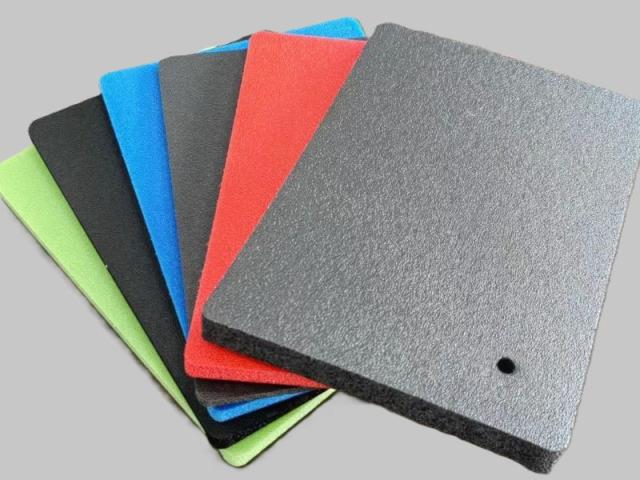
XPE foam is a good default for closed-cell cushioning, insulation and sealing. This page is about the other half of the picture: the properties that make XPE the wrong choice for some jobs, and what to use instead. If you are choosing a material for a specific part, these are the limits that usually decide it.
What XPE foam is, in one paragraph
XPE is polyethylene foam cross-linked with a chemical agent before expansion. The cross-linked network gives it dimensional stability, a closed cell structure, and a memory that brings it back to its original thickness after compression. We produce it from 3x to 40x expansion — roughly 300 kg/m³ down to 26.8 kg/m³ — in single layers of 3–15 mm and laminated blocks of 15–200 mm, at widths up to 2000 mm.
1. It costs more than plain PE foam
Cross-linking adds a process step and a chemical agent, so XPE sits above non-cross-linked PE foam at the same density. If the part is a single-use void filler, or a block whose only job is to take up space in a carton, plain PE or EPE is the cheaper answer and does that job just as well.
2. Cross-linking makes end-of-life recycling harder
Uncross-linked PE can be melted and re-pelletised. Cross-linked PE cannot: the network holds it together, so it does not flow. XPE offcuts are therefore harder to feed back into a mechanical recycling stream than plain PE, and in most markets the realistic end-of-life route is energy recovery. If your customer specifies recycled content or a closed-loop take-back, that is a material decision — raise it before the design is fixed.
We do keep the cut waste down: nesting is done at the cutting stage, and offcuts are reused wherever a smaller part can be cut from them.
3. There is a temperature ceiling
XPE is a polyethylene, and polyethylene softens as it gets hotter. For ordinary grades the working range is well below the PP-based foam: our IXPP is rated for a maximum service temperature of 140 °C and is stable in boiling water. If a part sits in an engine compartment, next to a battery cell, or anywhere that sees sustained heat, IXPP is the material to look at.
We also supply a high-temperature XPE grade, specified for a 110 °C working environment with dimensional change of no more than 8 %. Between the standard grade and that one there is a gap, and above it there is IXPP.
4. A single layer starts at 3 mm
XPE is made in single layers from 3 mm upward. Below that there are three options: switch to IXPE, which is irradiation cross-linked and can be produced down to 0.1 mm in one layer; laminate thin layers together, which adds cost and puts a glue line inside the part; or redesign the part so a thicker foam does the job.
5. It takes a compression set under sustained load
Every flexible foam does, and XPE is no exception. Measured to GB/T 6669 at 23 ± 2 °C over 22 hours, compression set runs from ≤2 % at 3x expansion to ≤11 % at 35–40x. The lighter the foam, the more it gives up under a long static load. For a gasket, pad or spacer that stays compressed for years, design around it: a denser grade, a thicker part, or a material with better recovery.
6. UV and weathering
Polyethylene is not UV-stable on its own. Indoors, or outdoors for a season, XPE is fine. For a part that stays in the sun for years — a mat, a float, a sign backing — specify a UV-stabilised grade or cover the foam. This is a formulation question rather than a foam-type question, and it has to be settled when the order is placed.
7. Not every adhesive or solvent is compatible
XPE bonds well to most pressure-sensitive adhesives and laminates cleanly to film, foil, fabric and non-woven. It is not resistant to every solvent, and some adhesives need a corona-treated surface to hold on a low-energy polyethylene. We corona-treat where adhesion matters. If your process uses a solvent elsewhere in the plant, send us the name and we will test the combination instead of assuming it.
8. It is not a structural material
XPE cushions; it does not carry load. Compressive strength is low by design, and it will not hold a shape or a weight the way wood, metal or a rigid plastic does. It is usually used alongside them — as the interface that absorbs the impact — which is a different job.
9. Custom shapes need tooling
Die-cutting a part means building a die, and a die is a fixed cost that only pays back at volume. For a prototype, a small batch, or a design that is still changing, CNC routing cuts from the drawing without tooling. We run both, so the choice is about your quantity and your timeline.
Where XPE is still the right choice
- Closed-cell cushioning where low water absorption matters.
- Thermal insulation at moderate temperatures — 0.040 to 0.095 W/m·K, depending on density.
- Packaging inserts, trays and case liners that need a clean, dimensionally stable part.
- Flooring and construction underlayment, where compression set at 3x–20x stays low.
- Any part that is compressed and released many times and has to spring back.
FAQ
Is XPE foam water-resistant?
It is closed-cell. Water absorption measured to GB/T 1034 at 23 °C over 22 hours is ≤0.2 % at 3x–10x and ≤0.4 % at 25x–40x. That makes it water-resistant — not a vapour barrier, and not a material for continuous immersion.
Can XPE foam be recycled?
It can be ground and used as filler, but it cannot be melted and re-formed the way uncross-linked PE can. Plan for energy recovery unless your market has a specific route for cross-linked PE.
Can XPE be used outdoors?
Yes, with a UV-stabilised grade. Standard grades are intended for indoor use or for parts that are covered.
What if the part runs hot?
Our high-temperature XPE grade is specified for a 110 °C working environment. Above that, or where heat comes with a sustained load, IXPP is rated for 140 °C. Tell us the temperature, how long it lasts, and the load on the part.
Related reading
XPE foam: specifications and grades · IXPE foam: thin gauges · IXPP foam: heat resistance · All foam materials
If a part is running into one of these limits, send the drawing and the operating conditions and we will tell you whether XPE works or which grade to use instead.