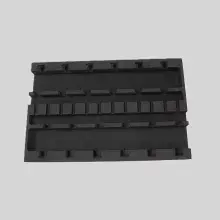
Foam dunnage is the protective material packed around a load to stop it moving, absorbing the shock of transport and filling the void between the product and its container. Bofeng Foam manufactures foam dunnage in Zhuhai, China, in densities from 26.8 to 300 kg/m³, supplied as planks, shaped blocks, trays and die-cut parts.
Packaging failures usually come from movement rather than from impact alone. A product that can shift inside its case will find a hard surface to hit, however good the outer box is. Dunnage removes that freedom, which is why the specification starts from the void to be filled and the load it has to hold rather than from the foam.
What is foam dunnage?
Dunnage works on two principles at once. It blocks, filling the void so the product cannot move, and it cushions, deforming to absorb energy when the package is dropped or the pallet is jolted. A good dunnage design does both: it locates the product firmly enough that it does not shift in transit, without gripping it so tightly that the foam transmits the shock straight through.
Cross-linked PE foam suits this because it is closed-cell and dimensionally stable. It does not absorb water in a damp warehouse or a humid container, and it does not collapse under a stacked load the way a loose fill would. It can also be cut to the exact void, so the block is a designed part rather than a quantity of stuffing.
- Blocks and cushions — stops movement and absorbs the shock at the same time, which is what a well-designed dunnage part does.
- Closed-cell and stable — no water absorption, so performance holds in humid containers and unheated warehouses.
- Wide density range — 26.8–300 kg/m³ covers light void fill through to heavy load-bearing blocks.
- Cut to the void — die-cut and CNC-contoured parts, so the dunnage locates the product repeatably.
- Load bearing — holds the weight of stacked containers without progressively flattening.
Foam materials used for foam dunnage
Dunnage is specified from the load and the void, and the material follows from those.
- XPE foam — chemically cross-linked polyethylene foam. Closed-cell, produced at 3–40× expansion with a density range of 26.8–300 kg/m³, in single layers of 3–15 mm. The general-purpose grade for most industrial work. View XPE foam →
- IXPE foam — radiation (electron-beam) cross-linked polyethylene foam. The finer cell structure allows single layers down to 0.1 mm with a smoother, more uniform surface. View IXPE foam →
- IXPP foam — radiation cross-linked polypropylene foam. Stiffer and more heat resistant than PE foam, with a maximum service temperature up to 140 °C. View IXPP foam →
| Material | Cross-linking | Expansion ratio | Width | Single-layer thickness | Heat-bonded multi-layer |
|---|---|---|---|---|---|
| XPE foam | Chemical (peroxide) | 3–40× | 500–2000 mm | 3–15 mm | 15–200 mm |
| IXPE foam | Radiation (electron beam) | 3–40× | 500–2000 mm | 0.1–15 mm | 15–200 mm |
| IXPP foam | Radiation (electron beam) | 5–25× | 500–1500 mm | 1–6 mm | 6–100 mm |
Heavy loads and stacked pallets call for a firmer, denser XPE part. Where the dunnage also has to protect a delicate surface in contact with the product, a softer IXPE facing over a firmer core — laminated in house — gives both. Where the container sits in heat, IXPP extends the service ceiling to 140 °C.
Designing dunnage that actually works
Four inputs decide the design, and they are the questions we ask before quoting a dunnage part.
- Product mass and centre of gravity — determines how much load the foam has to carry and where it needs to be supported.
- Transit environment — the drop height and the vibration profile of the journey. A long sea freight leg and a parcel network impose very different loads.
- Void geometry — the space between the product and the container wall, which sets the thickness available and therefore the density needed.
- Handling — whether the dunnage is reused, how it is packed by the operator, and whether it has to interlock or stack flat for storage.
Where the dunnage is also the visible packaging — a foam tray inside a printed box, for example — the same part can present the product as well as protect it. See the foam tray page and our custom foam inserts guide for that case.
Foam dunnage products we manufacture
- Custom foam inserts — die-cut and CNC-contoured protective inserts
- Packaging foam — protective packaging built around the product
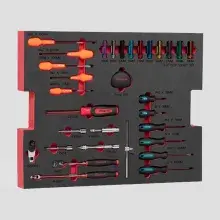
- Tool box foam insert — shaped dunnage for tool and equipment cases
- Glass packaging foam insert — blocks and separators for fragile panels
- Ceramic packaging foam insert — impact protection for ceramics
- Hardware packaging foam insert — dunnage for heavy metal parts
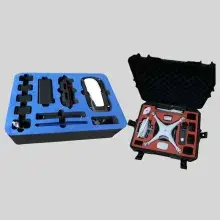
- Drone packaging foam insert — locating dunnage for delicate equipment
- Shadow foam — contoured foam that locates every tool in a set
Typical applications
- Export and sea freight packaging
- Palletised goods and stacked container loads
- Tool boxes, flight cases and equipment cases
- Fragile items — glass, ceramics, instruments
- Heavy hardware and machined part shipping
- Reusable returnable packaging systems
Why choose Bofeng Foam?
Bofeng Foam is a direct factory manufacturer of cross-linked polyethylene foam in Zhuhai, China, with more than 10 years of experience in the foam industry. We run both chemical and radiation cross-linking in house, which means the material grade, density and surface finish can all be matched to your application rather than picked from a fixed catalogue.
- Both cross-linking routes in house — chemical (XPE) and electron-beam radiation (IXPE, IXPP), so you are not pushed towards one material for supply reasons.
- Wide grade coverage — expansion ratios from 3× to 40× and densities from 26.8 to 300 kg/m³, with single-layer thickness from 0.1 mm and heat-bonded multi-layer stock up to 200 mm.
- Converting under the same roof — die-cutting, CNC contouring, lamination, adhesive coating and slitting, so a finished part arrives instead of a roll.
- Functional grades when the application demands it — flame retardant (limiting oxygen index 27, meeting GB 8410 A0 and UL94 V2 requirements), heat resistant (110 °C, shrinkage ≤8%) and conductive (10³–10⁶ Ω) or anti-static (10⁶–10⁹ Ω).
- Engineering-led specification — send a drawing or a sample and our team will recommend the material, density, thickness and surface treatment that fit the load case, then confirm it against the GB/T test standards published on our material pages.
Request a quote for foam dunnage →
Send us the product dimensions, the weight and the container, and we will come back with a dunnage design — density, thickness and cut geometry — rather than a sheet quote. Because we make the foam and cut the part in the same factory, the density the design calls for is the density the finished part is made from.
Foam dunnage FAQ
What is foam dunnage used for?
Dunnage fills the space between a product and its container so the product cannot move, and absorbs the shock of transport. It is used in export packaging, palletised and stacked loads, equipment and tool cases, and for fragile or heavy items where the product would otherwise shift and strike a hard surface.
What density of foam should dunnage be?
That follows from the load and the void. Light products in a generous void use a high expansion ratio in the 25–40× range; heavier parts and stacked pallets move towards 10–20×; dense load-bearing blocks are made from the low end of our 26.8–300 kg/m³ density range. Give us the weight and the void and we will specify the ratio.
Does foam dunnage work for sea freight?
Yes, and the closed-cell structure is a real advantage there. Cross-linked PE foam does not absorb water, so a long humid container voyage does not leave the dunnage heavy, soft or mouldy, and it does not lose the stiffness that keeps the load restrained.
Can dunnage be reused?
Cross-linked PE foam has low compression set, so a dunnage part does not progressively flatten through repeated shipments. That makes it a reasonable choice for returnable packaging systems where the same insert is used many times, provided the part is handled so it does not tear.
Is foam dunnage recyclable?
Cross-linked polyethylene foam is a polyolefin, and the same material family is widely collected for recycling. Because dunnage parts are made in a defined material with no mixed contamination, a single-material insert is simpler to handle at end of life than a composite packaging assembly — one more reason to specify the dunnage as one material rather than several bonded layers.
Related reading
See also: Custom foam inserts: packaging design guide · How to choose foam density and thickness · Closed cell vs open cell foam · XPE foam vs IXPE: what is the difference.