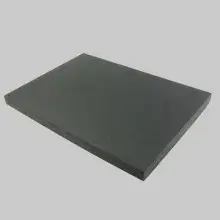
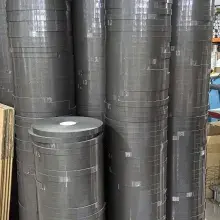
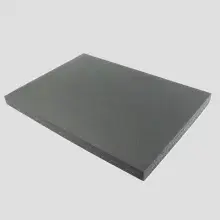
Sealing foam is compressible closed-cell polyethylene foam used to close the gap between two surfaces so that air, water, dust or noise cannot pass. Bofeng Foam manufactures sealing foam in Zhuhai, China, in single layers from 0.1 mm (IXPE) and with water absorption of 0.2% or less, which is what makes a thin PE gasket a reliable seal rather than a sponge.
A foam seal works by being compressed. The foam pushes back against the two surfaces, and that restoring force is what keeps the joint closed through thermal movement, vibration and the relaxation that follows any long-term compression.
What is sealing foam?
Two properties decide whether a foam will seal. The first is compression set: how much of its thickness the foam keeps after being squeezed for a long time. A foam that takes a permanent set stops pushing back, and the joint leaks. Cross-linked PE foam holds its thickness far better than a thermoplastic foam, because the cross-linked network stops the cells from flowing.
The second is water absorption. A seal that wicks moisture into the joint fails in two ways at once: it stops blocking water, and in cold conditions the trapped moisture can freeze and push the joint open. Closed-cell PE foam absorbs 0.2% or less by the GB/T 1034 method 4 test, so the seal stays a seal.
- Low compression set — the cross-linked network keeps the foam pushing back after long-term compression, so the seal does not relax away.
- Closed cells — water absorption of 0.2% or less means the gasket does not wick or freeze.
- Ultra-thin gauges — IXPE down to 0.1 mm single layer, which is what tight modern enclosures and electronics require.
- Conformable — soft enough to follow a surface that is not perfectly flat, firm enough to hold the joint closed.
- Adhesive-backed options — pressure-sensitive adhesive on one or both faces lets the gasket be positioned and held during assembly.
Foam materials used for sealing foam
Sealing is the application where the difference between the three materials is largest, because it is driven by the thickness the joint can accept.
- XPE foam — chemically cross-linked polyethylene foam. Closed-cell, produced at 3–40× expansion with a density range of 26.8–300 kg/m³, in single layers of 3–15 mm. The general-purpose grade for most industrial work. View XPE foam →
- IXPE foam — radiation (electron-beam) cross-linked polyethylene foam. The finer cell structure allows single layers down to 0.1 mm with a smoother, more uniform surface. View IXPE foam →
- IXPP foam — radiation cross-linked polypropylene foam. Stiffer and more heat resistant than PE foam, with a maximum service temperature up to 140 °C. View IXPP foam →
| Material | Cross-linking | Expansion ratio | Width | Single-layer thickness | Heat-bonded multi-layer |
|---|---|---|---|---|---|
| XPE foam | Chemical (peroxide) | 3–40× | 500–2000 mm | 3–15 mm | 15–200 mm |
| IXPE foam | Radiation (electron beam) | 3–40× | 500–2000 mm | 0.1–15 mm | 15–200 mm |
| IXPP foam | Radiation (electron beam) | 5–25× | 500–1500 mm | 1–6 mm | 6–100 mm |
For very thin joints — electronics enclosures, display bezels, precision gaskets — IXPE is the only grade that reaches 0.1 mm. For general gaskets and weather seals, XPE in 3–15 mm is the workhorse. Where the seal sits next to heat, IXPP extends the service ceiling to 140 °C.
How to specify a foam gasket
A foam gasket is specified from the joint, not the other way round. We need four things: the gap to be filled, the compression the assembly can apply, the environment (temperature, water, UV), and whether the joint will be opened and closed again.
- Thinner gaps — 0.1–1 mm calls for IXPE, which is also the grade with the smoothest surface for a precision seal.
- Typical enclosures and weather seals — 3–15 mm of XPE, cut to a profile or supplied as tape.
- Reopened joints — choose a lower density so the foam recovers its thickness each time the joint is released.
- Permanent joints — a higher density packing more restoring force into the gap is usually the better seal.
For gaskets that must perform in a specific application, see foam gaskets, or the automotive foam and air conditioner panel foam pages for two worked cases.
Sealing foam products we manufacture
- Foam gasket — die-cut and profile-cut sealing gaskets
- Air conditioner panel foam — sealing and insulation behind appliance panels
- Door and window caulking foam — backer and seal for frame joints
- Automotive foam — body sealing and gaskets in vehicles
- Electronic product packaging liner foam — protective and sealing liners for electronics
- Medical tape foam — thin foam carriers for medical adhesive products
Typical applications
- Appliance and enclosure gaskets
- Automotive body seals and trim gaskets
- Door, window and frame sealing
- HVAC panel and duct joints
- Electronics bezels and display seals
- Hatch, locker and cabinet seals
Why choose Bofeng Foam?
Bofeng Foam is a direct factory manufacturer of cross-linked polyethylene foam in Zhuhai, China, with more than 10 years of experience in the foam industry. We run both chemical and radiation cross-linking in house, which means the material grade, density and surface finish can all be matched to your application rather than picked from a fixed catalogue.
- Both cross-linking routes in house — chemical (XPE) and electron-beam radiation (IXPE, IXPP), so you are not pushed towards one material for supply reasons.
- Wide grade coverage — expansion ratios from 3× to 40× and densities from 26.8 to 300 kg/m³, with single-layer thickness from 0.1 mm and heat-bonded multi-layer stock up to 200 mm.
- Converting under the same roof — die-cutting, CNC contouring, lamination, adhesive coating and slitting, so a finished part arrives instead of a roll.
- Functional grades when the application demands it — flame retardant (limiting oxygen index 27, meeting GB 8410 A0 and UL94 V2 requirements), heat resistant (110 °C, shrinkage ≤8%) and conductive (10³–10⁶ Ω) or anti-static (10⁶–10⁹ Ω).
- Engineering-led specification — send a drawing or a sample and our team will recommend the material, density, thickness and surface treatment that fit the load case, then confirm it against the GB/T test standards published on our material pages.
Request a quote for sealing foam →
Because we can supply IXPE at 0.1 mm and XPE up to 15 mm from the same plant, the same supplier covers both the precision seal and the general gasket in one assembly. Tell us the gap and the compression available and we will match the grade and the density to it.
Sealing foam FAQ
What thickness of sealing foam do I need?
Match it to the gap plus the compression you can apply. A common approach is to choose a foam roughly 1.5 to 2 times the gap, so the assembly compresses it by about 30–50% and the restoring force keeps the joint tight. For joints under a millimetre, IXPE at 0.1 mm and up is the material to use.
Will the foam take a permanent set and stop sealing?
Cross-linked PE foam resists this much better than thermoplastic foam, because the cross-linked network does not flow under sustained load. Even so, all foam relaxes to some degree, which is why the specification should build in compression rather than rely on exact thickness. In a joint that is opened and closed repeatedly, choose a lower density so the foam recovers each time.
Can the sealing foam be supplied with adhesive on one side?
Yes. We coat pressure-sensitive adhesive on one or both faces, and supply the gasket as a cut part or as a tape on a release liner. This is the usual format when the seal has to be held in position during assembly before the joint is closed.
Does sealing foam work outdoors?
Yes. The closed-cell structure means it does not absorb water, which is the main failure mode for an outdoor seal. UV exposure over many years will eventually affect the surface appearance of unfaced foam, so for long-term exterior use we normally recommend a faced or laminated construction rather than bare foam.
What is the difference between sealing foam and caulking foam?
They solve the same problem at different scales. Caulking foam fills and seals a building joint such as a window or door frame, where the gap is several millimetres and some movement has to be absorbed. Sealing foam as a gasket is a precision part, often die-cut to a profile, that closes a joint inside a product or enclosure.
Related reading
See also: XPE vs IXPE vs IXPP foam guide · Ultra-thin IXPE foam for electronics and keyboards · Foam lamination: four methods · Closed cell vs open cell foam.