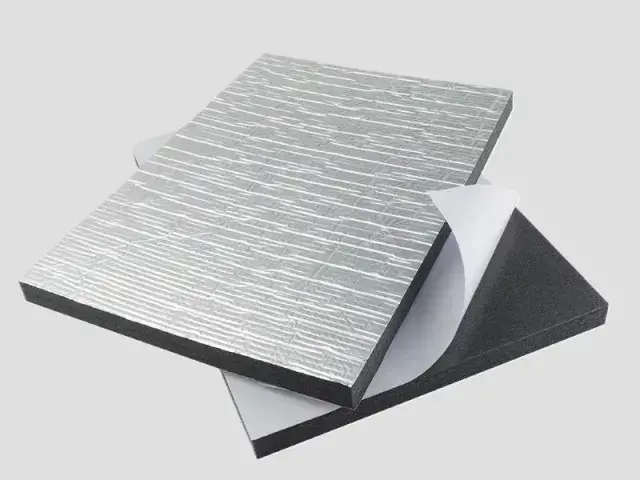
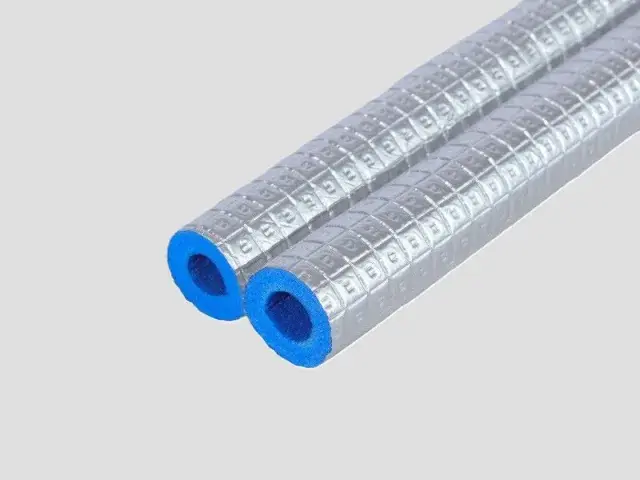
- Material: XPE foam + aluminum foil (aluminum film)
- Expansion ratio: 30 times (33 kg/m³)
- Width: 1 m, 1.2 m, 1.5 m (width can be customized)
- Thickness: single-layer 3–15 mm, thermally laminated (multi-layer) 15–200 mm
- Flame retardant grade: UL94 HF-1, GB8624-B1
Customization
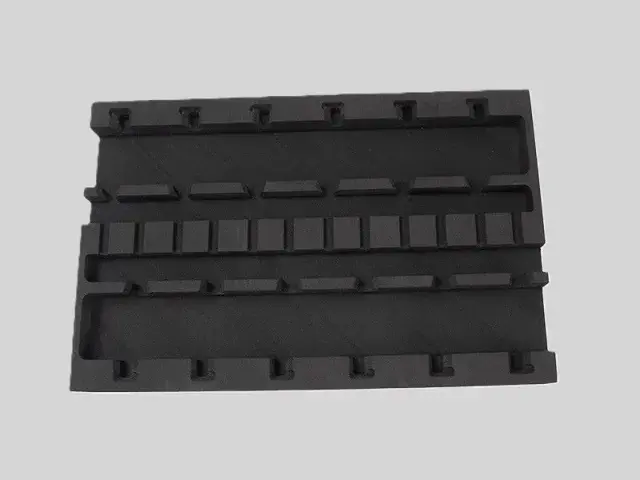
Made to order: density, thickness, colour and shape to your drawing. Die-cutting, CNC routing, lamination to film or fabric, slitting and adhesive coating all run in-house, so the part we quote is a finished part, not just a sheet. How a custom part is cut and routed explains what to send with the drawing.
Regular material: MOQ 1,000 m², lead time 15–20 days from order confirmation. Custom parts are quoted from the drawing. A4 samples are free, shipping included.
Central air-conditioning duct insulation foam is a foil-faced XPE sheet wrapped around the outside of supply and return ducts. Its job is twofold: stop conditioned air losing its temperature on the way to the room, and keep the duct surface above the dew point so that condensation does not form and drip.
Features
- Low thermal conductivity: the closed-cell XPE core resists conductive heat gain, while the aluminium foil facing reflects radiant heat away from the duct surface. The two mechanisms work together, which is why a foil-faced sheet outperforms a bare foam of the same thickness.
- Condensation control: holding the duct surface above dew point is what prevents the sweating that stains ceiling tiles, corrodes ductwork and drips onto occupants below.
- Foil facing as a vapour barrier: the aluminium layer also restricts moisture migration into the insulation, so thermal performance does not degrade over time.
- Light and conformable: unlike rigid board, the sheet bends around transitions, offsets and branch take-offs without special pre-formed fittings.
- Laminated thickness range: 3 mm to 15 mm as a single sheet, and 15 mm to 200 mm as a thermally laminated multi-layer build-up where a higher insulation value is required.
- Flame retardant grades: UL94 HF-1 and GB8624-B1.
Applications
- Commercial buildings – shopping malls, hotels and office towers
- Residential central air-conditioning systems
- Industrial workshops where temperature and humidity are controlled
- Hospitals, laboratories and schools
- Data centre and telecoms cooling distribution
Specifications for central air-conditioning duct insulation foam
Duct insulation works over a large surface, so thermal conductivity and water uptake drive the choice.
| Foam | Expansion | Apparent density | Single-layer thickness | Why this grade |
|---|---|---|---|---|
| XPE | 8–15× | 66.7–125 kg/m³ | 3–15 mm (heat-bonded 15–200 mm) | Conductivity down to 0.065 W/m·K and absorption under 0.2%, which is what keeps a cold duct from sweating. Heat bonding gives the thicker wrap. |
| IXPE | 15–25× | 40–66.7 kg/m³ | 0.1–15 mm | Used on duct bends and flexible sections where a rigid sheet will not follow the run. |
Base material specifications are on the XPE, IXPE and IXPP material pages; finished products are on the XPE foam and IXPE foam pages. Tell us the load, the space available and the service temperature and we will confirm the grade against your drawing.
Why Choose Bofeng Foam
We foam the XPE core and bond the aluminium foil facing in-house, so duct insulation is supplied at 30× foaming (33 kg/m³), in widths of 1 m, 1.2 m and 1.5 m, from 3 mm single sheet to 200 mm laminated board, and to UL94 HF-1 and GB8624-B1. Widths, thicknesses and facings are made to order. The same foil-faced construction is used for air conditioner panel foam, and the facing options are set out on the laminated foam page.
Where a foil facing helps and where it does not — the facing needs an air space — is covered in our aluminium foil insulation foam article.
Conclusion & Inquiry
Send the duct dimensions, the supply-air temperature and the ambient humidity the run passes through, and we will confirm the thickness and build-up. See XPE foam for the base material data, or contact us for a quotation.