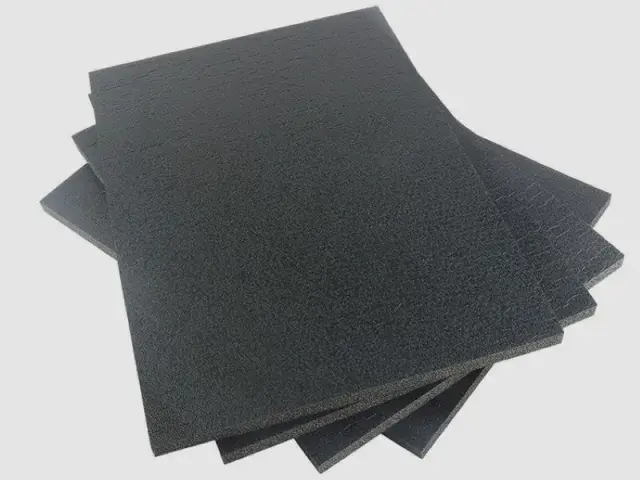
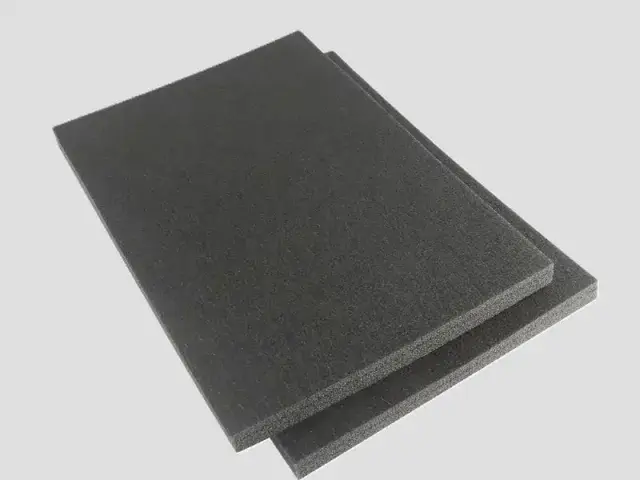
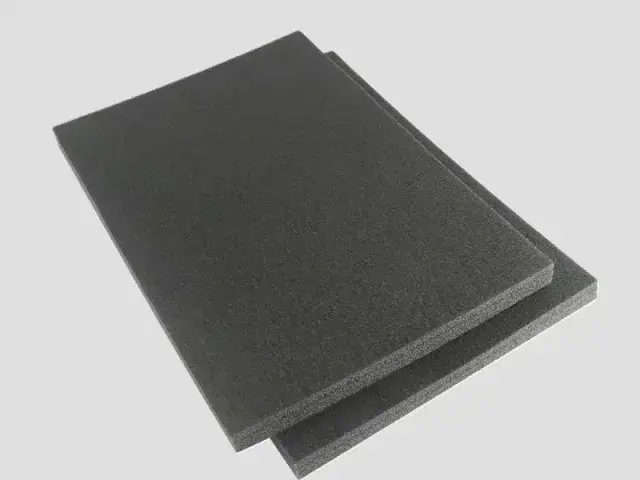
- Material: XPE foam, IXPE foam; elastomeric (NBR/PVC) foam on request
- Expansion ratio: 30 times (33 kg/m³)
- Thickness: 2 mm, 5 mm, 10 mm (thickness can be customized)
- Colour: white, gray (colour can be customized)
- Flame retardant grade: UL94 HF-1, GB8624-B1
Customization
Made to order: density, thickness, colour and shape to your drawing. Die-cutting, CNC routing, lamination to film or fabric, slitting and adhesive coating all run in-house, so the part we quote is a finished part, not just a sheet. How a custom part is cut and routed explains what to send with the drawing.
Regular material: MOQ 1,000 m², lead time 15–20 days from order confirmation. Custom parts are quoted from the drawing. A4 samples are free, shipping included.
Air conditioner pipe insulation foam is a flexible sleeve material wrapped around the refrigerant and condensate pipes that connect an indoor unit to the outdoor condenser. It keeps the suction line from gaining heat, stops the cold pipe from sweating, and takes the rattle out of a pipe run that would otherwise transmit vibration into the wall.
Features
- Closed-cell thermal barrier: the fine closed pores in the XPE or IXPE core block conductive heat transfer, which is what keeps a cold refrigerant line cold all the way to the evaporator.
- Condensate control: a cold pipe in humid air will form water; wrapping it in closed-cell foam keeps the surface temperature above dew point so the pipe stays dry.
- Flexible and easy to bend: the sheet wraps tightly around bends, offsets and tight radius elbows that a rigid sleeve cannot follow.
- Water and rot resistant: the surface absorbs very little water, so the wrap keeps its thermal performance even in a damp plant room or a coastal installation.
- Temperature, water and chemical exposure requirements must be verified for the specific core, facing and adhesive; no unrestricted outdoor or chemical resistance is declared.
- Flame retardant grades: UL94 HF-1 and GB8624-B1.
Applications
- Split and multi-split air conditioners – the indoor-to-outdoor connecting pipe run
- Central plant chilled-water and refrigerant pipework
- Commercial buildings – hotels, malls and office fit-outs
- Cold rooms and refrigeration plant
- Automotive and marine air-conditioning lines
Specifications for air conditioner pipe insulation foam
Copper and refrigerant pipe insulation has to close round the pipe and stay closed through thermal cycling.
| Foam | Expansion | Apparent density | Single-layer thickness | Why this grade |
|---|---|---|---|---|
| XPE | 15–25× | 40–66.7 kg/m³ | 3–15 mm | The usual wrap grade: flexible, closed-cell against condensation, with conductivity of 0.049–0.065 W/m·K. |
| IXPE | 25–35× | 28.6–40 kg/m³ | 0.1–15 mm | Thinner wrap for service pipe and tight radii inside a unit. |
Base material specifications are on the XPE, IXPE and IXPP material pages; finished products are on the XPE foam and IXPE foam pages. Tell us the load, the space available and the service temperature and we will confirm the grade against your drawing.
Second material option: elastomeric foam
Pipe insulation for AC lines can also be supplied in elastomeric foam – an NBR rubber and PVC blend, sold as rubber-plastic pipe insulation. It comes as tube, which slides onto a straight run, and as sheet for elbows, tees and valves.
| Property | Standard grade |
|---|---|
| Apparent density | 40–95 kg/m³ |
| Thermal conductivity | ≤0.036 W/(m·K) at 0 °C mean temperature |
| Service temperature | -40 °C to +105 °C |
| Flame class | B1 (GB 8624) |
| Wall thickness | 9, 13, 15, 20, 25 and 30 mm |
These are the standard values the material is sold to (GB/T 17794). The grade we quote is confirmed against your drawing.
Which family to use: PE foam covers the wider range of thickness – 0.1 mm in a single layer for IXPE, up to 200 mm once layers are laminated – and takes a foil facing, an adhesive backing or a die-cut part, which is what split-system connecting pipes and tight indoor runs need. Elastomeric foam conducts less heat at the same wall (≤0.036 against ≤0.045 W/(m·K) for 30× XPE), and because it arrives as tube, long straight runs such as refrigerant mains and condensate risers take less time on site.
One run normally uses one family throughout: the two shrink differently and the joint is where that shows. Elastomeric foam is available in white, black and dark grey. Send us the pipe diameter, the line temperature, the ambient humidity and the fire requirement of your market, and we will confirm material and wall thickness.
Why Choose Bofeng Foam
We supply AC pipe wrap at 30× foaming (33 kg/m³) in XPE or IXPE, in thicknesses of 2 mm, 5 mm and 10 mm, in white or gray, and to UL94 HF-1 and GB8624-B1. Thickness and colour are made to order, and the wrap can be supplied with an adhesive backing or cut to width for a specific pipe diameter. For larger industrial runs, see pipe insulation foam; the irradiation-cross-linked option is described on the IXPE foam page.
Why pipe insulation has to be closed-cell, and how the thickness is chosen for a given line temperature, is set out in our pipe insulation guide.
Air-Conditioner Pipe Wrap: Review the Fittings Before Ordering the Roll
Map the Whole Refrigerant Run
Identify pipe sections, bends, tees, valves, supports and access points. Provide operating temperatures, surrounding humidity and the available space. A straight-pipe sample does not show whether the same build can be fitted around a crowded valve or maintained later without an exposed gap. Include intermittent and start-up conditions where these matter to the requirement.
Specify the Wrap and Seam Detail
State foam, facing, adhesive, joint arrangement and fixing together. Keep actual thickness at bends and supports in the review. Pulling a wrap tightly can change its geometry; it should not be assumed equivalent to a flat specimen. The system design must detail continuity at interruptions and how access sections are restored after maintenance.
Compare Materials on Their Own Evidence
If elastomeric insulation is proposed, identify its particular grade separately from XPE or IXPE. Industry-standard example values are not factory test results or proof of stock. Compare methods and conditions before using a conductivity result, and check the full construction instead of assuming every option has the same fire, bond or exposure performance.
Inspect Under the Agreed Duty
Record the installed run before concealment. Wetness at a fitting or support calls for checking that detail; low water uptake alone does not prove condensation control. Agree operating conditions and verification with the responsible designer. We confirm material and converting to a defined build without universal wrap thickness or unrestricted chemical-exposure guarantees.
For sample identity, dimensions and the acceptance record, use the first-article review checklist with the application-specific checks above.
Turning a pipe insulation enquiry into an installation schedule
Identify the pipe system and the service conditions
Provide the pipe material, outside dimensions and the proposed route with the operating conditions supplied by the system designer. Distinguish straight runs, bends, supports, valves and connections. State whether the enquiry concerns a prefabricated sleeve, a cut wrap or a fabricated part. The fact that a foam appears on a pipe insulation page does not select a grade or thickness for a particular refrigerant line or building. That selection belongs to the project design and its applicable requirements.
Give the supplier the intended installation location and any jacket, adhesive or closure system already specified. Conditions at an indoor concealed run and an exposed service area may call for different review. Identify the actual material proposed for each part of the assembly. The NBR/PVC information on this page is explicitly an industry reference, and an order still needs a confirmed grade and construction. It must not be treated as a factory test certificate for an unspecified product.
Plan the joints and interruptions
Mark where the insulation opens or terminates and how those locations are to be finished. Include fittings and maintenance access rather than showing only an uninterrupted length of tube. Ask the installer to review whether the proposed pieces can be fitted in the available space and whether the closure can be completed as intended. A suitable straight sleeve does not by itself resolve the shape and sealing of a complicated connection.
Support positions need their own detail. Show how the insulation and any jacket relate to the support hardware and which components are supplied by others. Do not assume that increasing the nominal foam thickness corrects a locally compressed or discontinuous assembly. Where the project has a specified vapour control or sealing detail, include it in the sample review. Claims about condensation performance require the actual system and design conditions, not merely a closed cell material description.
Approve material choices separately
If comparing PE foam with elastomeric foam, keep a separate record for each proposed construction. Compare the intended dimensions, joining method, installation access and evidence required by the project. Do not transfer a temperature, fire classification or thermal result from one family to the other. Even within a family, the report must correspond to the selected grade and the relevant test conditions. Ask for supporting documents by grade rather than accepting a generic claim about all pipe insulation.
Use the first article or an agreed installation sample to resolve fit and workmanship questions before ordering the complete schedule. Record the grade, drawing, closure materials and installation method that were reviewed. Define who approves changes at fittings or during site installation. A repeat order should refer to that schedule and confirmed construction so a procurement substitution is visible to the people responsible for the system design.
For a quotation, separate the confirmed schedule from items that still await design review. Identify where the requested material is a proposed alternative and list the supporting information needed to approve it. This allows a supplier to price a defined supply scope without implying that acceptance of a quotation constitutes engineering approval of the insulation system. If the project later changes the operating conditions, pipe dimensions or finishing products, update the schedule and refer the affected details for review. Keep the previous and revised configurations identifiable so material already delivered cannot silently be treated as approved for a different installation. Identify valves and maintenance access in the installation schedule.
Conclusion & Inquiry
Tell us the pipe diameter, the line temperature and whether the run is indoors or exposed, and we will specify the thickness. Contact us for samples or a quotation.