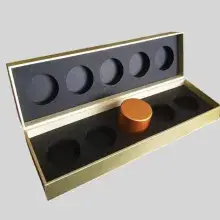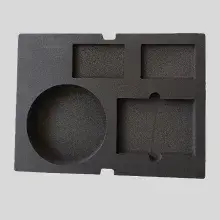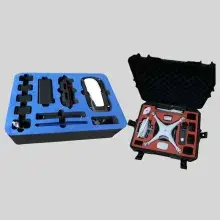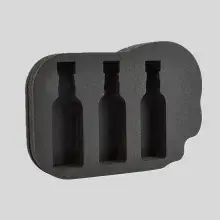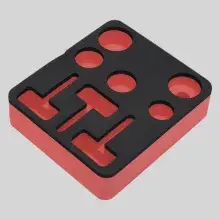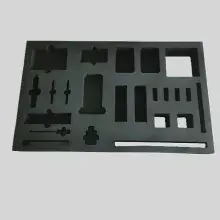
Foam tray is a shaped cross-linked polyethylene foam component that carries, separates and presents products through handling, storage and shipping. Bofeng Foam manufactures foam trays in Zhuhai, China, die-cut and CNC-contoured to the product, in densities from 26.8 to 300 kg/m³ and in conductive, anti-static and flame-retardant grades where the application requires them.
A foam tray does more than hold a part still. It sets the pitch at which parts are presented to an operator or a machine, it keeps components apart so they cannot touch or abrade, and it becomes the surface the product is seen on when the lid is opened.
What is foam tray?
A tray is a packaging component with an internal geometry. The pockets locate each part, the walls between them separate it from its neighbour, and the base absorbs the shock of the whole assembly. Get the geometry right and the tray is also the fixture the product is assembled and tested in; get it wrong and parts rattle, abrade or arrive in the wrong orientation.
Cross-linked PE foam is well suited because it holds a cut edge cleanly and keeps its thickness under load. A tray cut from a stable closed-cell sheet keeps the pitch between pockets constant through the whole production run, which matters when the tray is feeding an automated line rather than a person.
- Cut-to-product geometry — die-cut and CNC-contoured pockets that locate and separate parts.
- Stable thickness — consistent gauge keeps pocket depth and pitch repeatable across a production run.
- Closed-cell — water absorption of 0.2% or less, so trays do not soften or mark in humid storage.
- ESD grades available — conductive and anti-static versions for electronics handling — conductive 10³–10⁶ Ω, anti-static 10⁶–10⁹ Ω.
- Food-contact and presentation options — clean white foam where the tray is also the display surface.
Foam materials used for foam tray
Trays are cut from the same cross-linked base materials as our sheet stock, so the material is chosen for the job the tray does.
- XPE foam — chemically cross-linked polyethylene foam. Closed-cell, produced at 3–40× expansion with a density range of 26.8–300 kg/m³, in single layers of 3–15 mm. The general-purpose grade for most industrial work. View XPE foam →
- IXPE foam — radiation (electron-beam) cross-linked polyethylene foam. The finer cell structure allows single layers down to 0.1 mm with a smoother, more uniform surface. View IXPE foam →
- IXPP foam — radiation cross-linked polypropylene foam. Stiffer and more heat resistant than PE foam, with a maximum service temperature up to 140 °C. View IXPP foam →
| Material | Cross-linking | Expansion ratio | Width | Single-layer thickness | Heat-bonded multi-layer |
|---|---|---|---|---|---|
| XPE foam | Chemical (peroxide) | 3–40× | 500–2000 mm | 3–15 mm | 15–200 mm |
| IXPE foam | Radiation (electron beam) | 3–40× | 500–2000 mm | 0.1–15 mm | 15–200 mm |
| IXPP foam | Radiation (electron beam) | 5–25× | 500–1500 mm | 1–6 mm | 6–100 mm |
XPE is the standard tray material: firm enough to hold its geometry, economical, and available in the thicknesses trays usually need. IXPE is used where the tray has to be thin or the surface has to be smooth and uniform — liners and interleaves rather than deep pockets. IXPP is chosen where the tray also has to tolerate heat.
Tray construction and options
Trays are usually built up from more than one layer, and the combination is what makes the part work.
- Single-layer tray — one sheet cut with pockets, for shallow or light parts.
- Laminated tray — a cut pocket layer bonded to a solid base sheet, which gives real pocket depth without a thick block of foam.
- Pocket and lid — a matched pair so the product is enclosed from both sides when the box is closed.
- Conductive or anti-static — the carbon-compounded grades, cut to the same geometry, where the tray is part of an ESD control plan.
- Stacking features — locating steps or walls so loaded trays stack without crushing the parts below.
For trays that also have to present a product, see our foam tray example for produce; for the electronics case, see the ESD foam page. Our custom foam inserts guide covers the design process end to end.
Foam tray products we manufacture
- Conductive foam tray — trays for ESD-sensitive components
- Anti-static injection molded trays — trays for automated handling lines
- Anti-static blister trays — formed trays for component presentation
- Strawberry foam tray — presentation tray for produce
- Custom foam inserts — die-cut and CNC-contoured tray inserts
- Tool box foam insert — multi-pocket inserts for tool sets
- Drone packaging foam insert — locating tray for delicate equipment
- Glass packaging foam insert — separating trays for panels and sheets
Typical applications
- Component handling trays for electronics assembly
- Parts presentation on manual and automated lines
- Multi-pocket tool and equipment cases
- Fragile item separation in transit
- Produce and food presentation trays
- Returnable and reusable container inserts
Why choose Bofeng Foam?
Bofeng Foam is a direct factory manufacturer of cross-linked polyethylene foam in Zhuhai, China, with more than 10 years of experience in the foam industry. We run both chemical and radiation cross-linking in house, which means the material grade, density and surface finish can all be matched to your application rather than picked from a fixed catalogue.
- Both cross-linking routes in house — chemical (XPE) and electron-beam radiation (IXPE, IXPP), so you are not pushed towards one material for supply reasons.
- Wide grade coverage — expansion ratios from 3× to 40× and densities from 26.8 to 300 kg/m³, with single-layer thickness from 0.1 mm and heat-bonded multi-layer stock up to 200 mm.
- Converting under the same roof — die-cutting, CNC contouring, lamination, adhesive coating and slitting, so a finished part arrives instead of a roll.
- Functional grades when the application demands it — flame retardant (limiting oxygen index 27, meeting GB 8410 A0 and UL94 V2 requirements), heat resistant (110 °C, shrinkage ≤8%) and conductive (10³–10⁶ Ω) or anti-static (10⁶–10⁹ Ω).
- Engineering-led specification — send a drawing or a sample and our team will recommend the material, density, thickness and surface treatment that fit the load case, then confirm it against the GB/T test standards published on our material pages.
Request a quote for foam tray →
Send a drawing or a sample part and we will design the pocket geometry, choose the density and cut a trial. Because we produce the foam and cut the tray in the same factory, a tray that needs the firmer end of the range to hold its pockets can be made from exactly that grade rather than from whatever sheet is in stock.
Foam tray FAQ
What foam is used for trays?
Most trays are cut from cross-linked polyethylene foam in the firmer part of our range, because the material has to hold pocket geometry without sagging. Where the tray handles electronic components, the conductive or anti-static grades are used instead, at surface resistances from 10³ to 10⁶ Ω (conductive) or 10⁶ to 10⁹ Ω (anti-static). Where it also runs warm, IXPP extends the service ceiling to 140 °C.
Can foam trays be made conductive or anti-static?
Yes. The carbon-compounded grades are produced on the same base materials and cut to the same geometry, so an ESD tray is a material change rather than a redesign. Because conduction runs through the volume of the foam rather than sitting on the surface, the cut faces of the pockets remain conductive after machining.
How deep can the pockets be?
Depth comes from construction rather than from thickness alone. A single sheet gives a shallow pocket; bonding a cut pocket layer onto a solid base sheet gives real depth without using a thick block, which is how deep multi-layer trays are normally built. Tell us the part dimensions and the clearance you need and we will propose a build-up.
Are foam trays reusable?
Yes. Cross-linked PE foam has low compression set, so a tray does not progressively flatten under a repeated load, which makes it suitable for returnable packaging and for line-side handling trays that are filled and emptied many times a day.
Can foam trays be used for food?
Production trays are used for produce and food presentation. Bofeng Foam does not supply foam for direct food contact, so we cannot support that use. For industrial and consumer-product handling trays, send us the product, the load and the handling cycle and we will confirm the grade.
Related reading
See also: Custom foam inserts: packaging design guide · Conductive foam and ESD guide · How to choose foam density and thickness.