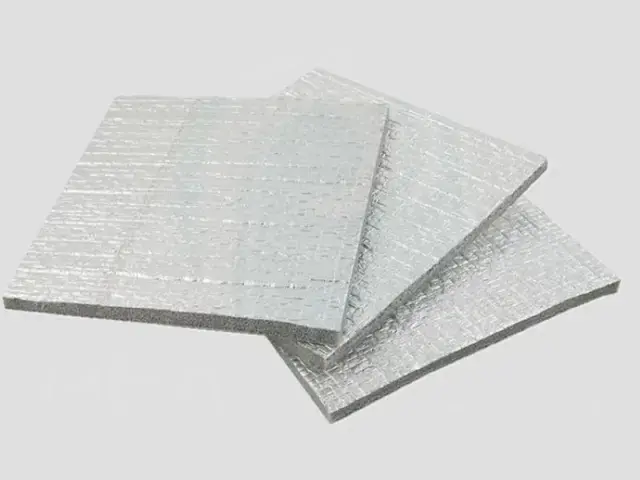
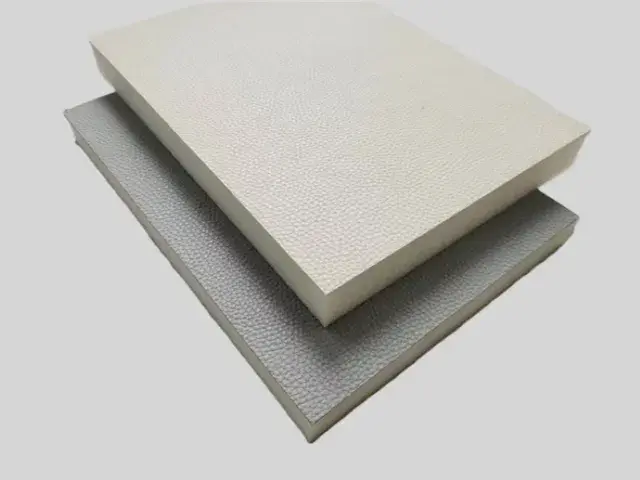
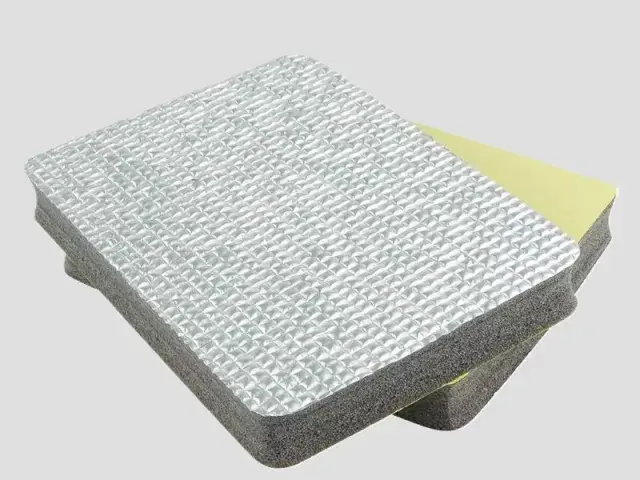
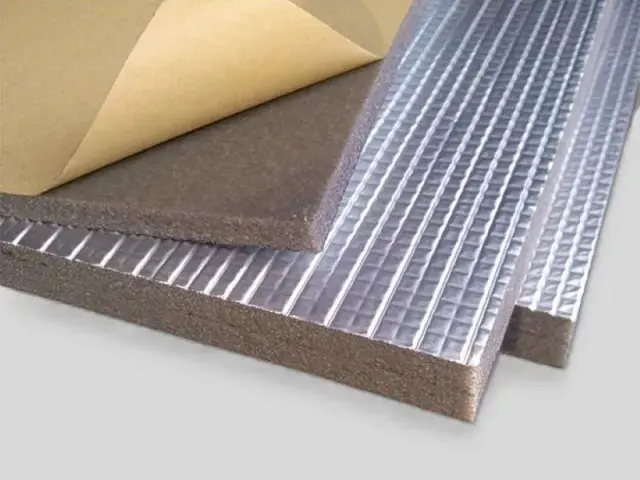
- Material: XPE foam + aluminum foil
- Expansion ratio: 30 times (33 kg/m³)
- Thickness: single-layer 3–15 mm, thermally laminated (multi-layer) 15–200 mm; one-side adhesive backing available
- Width: 1 m, 1.2 m, 1.5 m (width can be customized)
- Flame retardant grade: UL94 HF-1, GB8624-B1
Customization
Made to order: density, thickness, colour and shape to your drawing. Die-cutting, CNC routing, lamination to film or fabric, slitting and adhesive coating all run in-house, so the part we quote is a finished part, not just a sheet. How a custom part is cut and routed explains what to send with the drawing.
Regular material: MOQ 1,000 m², lead time 15–20 days from order confirmation. Custom parts are quoted from the drawing. A4 samples are free, shipping included.
A roof takes the most direct solar gain of any surface on a building and, in winter, it is where heat leaves fastest. Under a metal deck or a tiled pitch, a thin foil-faced foam layer addresses both: the foil turns radiant heat back before it reaches the deck, and the closed-cell foam underneath slows the conduction that follows.
This page is for the person specifying that layer: which grade, which thickness, how the foil has to be installed for it to do anything, and where the material's responsibility ends and the roof assembly's begins. It covers XPE and IXPE foam supplied as foil-faced sheet, in rolls and in cut panels, for pitched and low-slope roofs.
What the Layer Has to Do
- Cut summer heat gain. A bright foil facing reflects radiant heat from the deck before it is absorbed, which lowers the temperature the space below has to deal with.
- Slow winter loss. The closed-cell foam is the conductive barrier; its thermal conductivity, not its thickness alone, sets how much heat crosses.
- Stay dry. A roof layer lives in the wettest part of the building. Water absorption of 0.2% or less is what keeps the declared conductivity meaningful after a wet season.
- Not load the structure. Foam sheet weighs a fraction of a mineral board, so an existing roof can usually take it without a structural review.
- Follow the roof. Rolls and flexible panels bend over a profiled deck and cut around penetrations on site, which is where a rigid board becomes slow work.
Sensible specifications name one dominant job. A roof in a hot climate is a radiant-heat problem and the facing matters most; a roof over a heated building in a cold climate is a conduction problem and the foam grade matters most. A single layer rarely optimises both, which is why the build-up, not the product, is what should be designed.
Where It Goes in the Roof Build-Up
| Position | What the layer does there | Typical form |
|---|---|---|
| Under a metal roof deck | Breaks the radiant path from the hot deck and reduces condensation on its underside | Foil-faced roll, foil facing the air space |
| Over the deck, under the covering | Thermal break between the covering and the structure | Foil-faced panel or roll |
| Over a ceiling or suspended ceiling | Adds a radiant and conductive layer to an existing roof | Roll, laid across the joists |
| In a refurbishment | Adds insulation without raising the roof height | Thin IXPE sheet where depth is limited |
The position decides more than the grade. A layer installed directly under a metal deck with an air space above it behaves differently from the same layer pressed flat against the deck, even though the material is identical. Decide the position first and the thickness second.
The Foil Only Works With an Air Space
Foil is a radiant barrier, not a conductor's friend. Its benefit depends on a still air space on the reflective side, and it disappears when the foil is in contact with a surface that conducts. A foil-faced sheet pressed flat between two layers is mostly a conduction path with a shiny surface.
In practice that means three things. Keep the specified air space on the foil side and do not compress it with battens or fixings. Seal the laps and the edges, because an open edge lets the air space breathe and turns it into a convection path. And keep the foil clean during installation: dust, mortar and oil all raise the surface emissivity and reduce the reflection you paid for.
If the design has no room for an air space, say so. The foam still insulates, but it should be sold and specified as a conductive layer, not as a radiant barrier.
Closed Cell, Moisture and the Wet Season
XPE and IXPE are closed-cell foams, so they do not wick water into the cell structure the way an open-cell material does. In the XPE grades used under a roof, water absorption measures 0.2% or less after 22 hours at 23 °C by GB/T 1034 method 4. That figure is the reason a closed-cell layer keeps its declared conductivity after a wet season, while a material that has taken water measures as wet insulation from then on.
Closed cell does not turn the sheet into a vapour barrier. The foam resists water uptake but it is not a sealed membrane, and it does not replace the vapour control layer the assembly is designed around. Where a roof relies on a vapour barrier, the barrier stays in the design and the foam is placed on the side the design puts it.
Thermal Conductivity and What Density Buys You
Thermal conductivity across the XPE range runs from 0.095 W/(m·K) at 3× expansion to 0.040 W/(m·K) at 35× and above. A lighter, more expanded grade insulates better per millimetre, because more of its volume is gas rather than polymer. The trade is mechanical: the same expansion drop takes tensile strength and hardness down with it.
That is the whole design argument in one sentence. If the roof layer is protected and never walked on, choose the lightest grade that meets the fire requirement and take the better conductivity. If it has to survive foot traffic during installation, or hold a fixing, choose a denser grade and accept the thicker layer you need for the same performance. Verify the figure for the grade you are being quoted: a conductivity number quoted without its expansion ratio is not a specification.
Fire: Material Classification, Not a Roof Rating
The flame-retardant grades are supplied to LOI 27 and GB 8410 A0, and to UL94 V2 as well; a building classification of GB8624-B1 is available for the grades used in construction. Those are classifications of the foam as a material, measured on the foam.
They are not a rating of the roof. A roof's fire performance is assessed on the complete assembly — deck, foam, membrane, covering and fixings together — and that assessment belongs to the assembly's designer and to the authority having jurisdiction. A material classification is the input, not the result.
Cutting, Laps and Fixing
- Cutting. A sharp blade and a straight edge. Closed-cell foam cuts cleanly and does not fray, so the same sheet can be cut on site to follow a pitch or a penetration.
- Laps. Overlap as the assembly detail shows, and tape or seal the lap. The lap is a joint, not a decorative line.
- Fixing. Mechanically fix only where the detail allows, and avoid compressing the air space to do it. One-side adhesive backing is available for panels that have to sit flat during assembly.
- Sizes. Roll and sheet widths up to 2,000 mm, 500 mm minimum; single-layer 3–15 mm for XPE and 0.1–15 mm for IXPE, with heat-bonded multilayer from 15 mm to 200 mm where a thicker build is needed.
Specifications We Can Supply
| Property | XPE | IXPE |
|---|---|---|
| Expansion ratio | 3–40× | 3–40× |
| Apparent density | 26.8–300 kg/m³, grade-dependent | |
| Single-layer thickness | 3–15 mm | 0.1–15 mm |
| Heat-bonded multilayer | 15–200 mm | 15–200 mm |
| Thermal conductivity | 0.040–0.095 W/(m·K), grade-dependent (GB/T 10297) | |
| Water absorption | 0.2% or less to 0.4% or less, GB/T 1034 method 4 | |
| Dimensional change, 70 °C / 22 h | Shrinkage within 4% to 6% across and 6% to 8% along, by expansion ratio (GB/T 8811) | |
| Facing | Aluminium foil, one side or both; pressure-sensitive adhesive on request | |
| Flame-retardant grades | LOI 27, GB 8410 A0, UL94 V2; GB8624-B1 available for construction grades | |
Where This Layer Stops
- No U-value for your roof. We quote the foam's conductivity, not the assembly's U-value. The number your building code asks for is a property of the whole build-up — deck, cavity, foam, membrane, fixings and thermal bridges — and only the assembly's designer can state it.
- No vapour or condensation design. Where the dew point falls, and whether the assembly needs a vapour control layer, is a design decision. We can tell you the foam's water absorption; we cannot tell you that a roof will stay dry.
- No building approval and no system fire rating. GB8624-B1 is a material classification. It does not make a roof assembly compliant, and we do not issue an approval, a certificate of conformity for the assembly, or a fire rating for the roof.
- No install and no installed performance. We supply the material. A layer compressed flat, installed with the foil the wrong way round or left with open laps will not perform as measured, and we do not warrant workmanship we did not do.
- Not a walking surface and not a structural element. The foam does not carry foot traffic, does not brace the deck and does not replace a board where the design calls for one.
None of that makes the material weaker; it makes the boundary clear. Send the assembly drawing and the target performance, and the answer will separate what the foam can deliver from what the assembly has to.
Ordering, MOQ, Lead Time and Sample
- MOQ. 1,000 m² is the minimum for standard roll or sheet material. Cut panels and laminated builds are priced from the drawing and the project quantity.
- Lead time. Allow 15–20 days after the order is confirmed for standard material.
- Sample. The first step is a free sample: an A4 sheet of the chosen grade, sent with the freight paid, so the foil adhesion and the sheet stiffness can be checked before the order.
- What to send. The roof build-up, the position of the layer, the target performance, the fire requirement, the width you can handle and the total area.
FAQ
Which side should the foil face?
The side with the air space. In most under-deck installations that is the face towards the interior, which is also where the reflective benefit is wanted. A foil pressed against the deck is a conduction path.
Can the foam be used over an existing roof?
Yes, as an added layer where the build-up allows the height and the fixing. Whether the existing assembly can take the layer, and where it goes relative to the existing vapour barrier, is a question for the roof's designer.
Is XPE or IXPE better under a roof?
XPE for a layer that has to hold its shape and take handling on site; IXPE where the available depth is small, because its single-layer range starts at 0.1 mm. Both are closed cell and both are supplied foil-faced.
Does the foam meet the fire requirement for a roof?
We can supply flame-retardant grades to LOI 27 and GB 8410 A0, with UL94 V2 also available, and GB8624-B1 as a material classification. Whether that satisfies a roof requirement depends on the assembly and on the local authority, so ask for the classification of the material and the rating of the build-up separately.
How thick should the layer be?
Thick enough that the declared conductivity gives the performance the build-up needs, and no thicker if the roof cannot take the height. The conductivity is grade-dependent, so the thickness and the expansion ratio have to be chosen together.
Related Applications
Roof insulation is one position in a family of construction applications that share the same material and the same limits. Wall insulation foam applies the same foil-faced build to the vertical envelope, where the air space and the fixing detail are different. Flooring foam covers the layers under a floor build-up, including the acoustic ones. The thermal conductivity table by expansion ratio, and where the grade limits sit, is set out in our XPE foam insulation guide. Material data is on the XPE, IXPE and IXPP pages, and finished sheet ranges on XPE foam and IXPE foam. Send the assembly drawing and the target performance and the grade, the facing and the thickness will come back as a written confirmation.