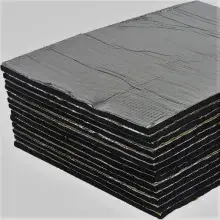
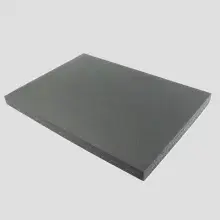
Soundproof foam is closed-cell polyethylene foam used to reduce the noise that travels through a structure, a vehicle body or a machine casing. Bofeng Foam manufactures soundproof foam in Zhuhai, China, in densities from 26.8 to 300 kg/m³ and thickness from 0.1 mm, in both plain and foil-faced form, so the layer can be tuned to whether the noise arrives through the air or through the structure.
Noise control is almost never solved by one material. Foam earns its place by decoupling surfaces, absorbing impact energy and closing the small gaps that let sound leak through a build-up that is otherwise solid.
What is soundproof foam?
Sound reaches a room by two routes. Airborne noise — speech, traffic, a compressor — travels as pressure waves in the air and is stopped by mass and by sealed joints. Impact noise — footsteps, a dropped tool, a vibrating panel — travels through the structure itself and is stopped by interrupting the path between the two sides.
Cross-linked PE foam is much better at the second problem, and it is very good at the gaps in the first. Laid under a floating floor, wrapped around a duct, or laminated behind a trim panel, it breaks the rigid contact that would otherwise carry vibration straight through. Because it is closed-cell it does not absorb water, which matters under a floor or inside a wall cavity where a wet absorber would lose effectiveness and become a problem of its own.
- Decoupling layer — a resilient sheet between two rigid surfaces stops structure-borne noise and the flanking paths around a partition.
- Gap filling — foam compresses into irregular joints, closing the leakage paths that undo an otherwise well-built acoustic assembly.
- Sealed cells — performance is unaffected by moisture, so it holds up under a floor or inside a cavity.
- Density range — 26.8–300 kg/m³ lets the layer be matched to the load it must carry and the frequency band that matters.
- Composite options — foil, non-woven and film facings can be laminated to add a reflective or protective surface.
Foam materials used for soundproof foam
For acoustic work the material matters less than the density and the thickness — but the grade still sets the limits on how thin the layer can be and how well it survives in service.
- XPE foam — chemically cross-linked polyethylene foam. Closed-cell, produced at 3–40× expansion with a density range of 26.8–300 kg/m³, in single layers of 3–15 mm. The general-purpose grade for most industrial work. View XPE foam →
- IXPE foam — radiation (electron-beam) cross-linked polyethylene foam. The finer cell structure allows single layers down to 0.1 mm with a smoother, more uniform surface. View IXPE foam →
- IXPP foam — radiation cross-linked polypropylene foam. Stiffer and more heat resistant than PE foam, with a maximum service temperature up to 140 °C. View IXPP foam →
| Material | Cross-linking | Expansion ratio | Width | Single-layer thickness | Heat-bonded multi-layer |
|---|---|---|---|---|---|
| XPE foam | Chemical (peroxide) | 3–40× | 500–2000 mm | 3–15 mm | 15–200 mm |
| IXPE foam | Radiation (electron beam) | 3–40× | 500–2000 mm | 0.1–15 mm | 15–200 mm |
| IXPP foam | Radiation (electron beam) | 5–25× | 500–1500 mm | 1–6 mm | 6–100 mm |
Under a floor, a denser XPE sheet carries the load without collapsing. Behind a thin panel or inside a vehicle door, a thin IXPE layer is the only material that fits the clearance. Where the assembly also runs warm, IXPP is the grade that keeps working up to 140 °C.
Specifying acoustic foam: what actually changes the result
Four things drive the acoustic outcome, and only one of them is the foam itself.
- Density — heavier foam resists deflection more and performs better against low-frequency impact noise; lighter foam performs better where it must stay soft.
- Thickness — more thickness buys more decoupling up to the point where the layer bottoms out under the service load, after which extra thickness stops helping.
- Completeness — an unsealed joint or a pipe passing through a wall can transfer more noise than the entire insulated area stops. This is the single most common reason a build-up underperforms.
- Structure — foam decouples; it is not a sound-absorbing panel for airborne reflections. Rooms that need reverberation control need a different treatment, and the two are usually combined.
For vehicle interiors specifically, our automotive foam page covers the sound-deadening build-up used behind trim, under carpet and inside doors.
Soundproof foam products we manufacture
- Acoustic foam — acoustic layers for building and equipment interiors
- Wall acoustic foam — decoupling layer behind wall linings
- Floor acoustic foam — impact-noise reduction under hard floor finishes
- Ceiling foam — noise control in ceiling build-ups
- Floor damping foam — vibration damping beneath flooring
- Automotive foam — sound deadening for vehicle bodies
- Tunnel seam splicing foam — seam filler in tunnel and infrastructure linings
Typical applications
- Floating floors and impact-noise reduction in apartments
- Partition walls, ceilings and shared walls
- Vehicle cabins, doors and under-carpet layers
- HVAC ducting and machine enclosures
- Tunnels and infrastructure lining systems
- Appliance and equipment vibration isolation
Why choose Bofeng Foam?
Bofeng Foam is a direct factory manufacturer of cross-linked polyethylene foam in Zhuhai, China, with more than 10 years of experience in the foam industry. We run both chemical and radiation cross-linking in house, which means the material grade, density and surface finish can all be matched to your application rather than picked from a fixed catalogue.
- Both cross-linking routes in house — chemical (XPE) and electron-beam radiation (IXPE, IXPP), so you are not pushed towards one material for supply reasons.
- Wide grade coverage — expansion ratios from 3× to 40× and densities from 26.8 to 300 kg/m³, with single-layer thickness from 0.1 mm and heat-bonded multi-layer stock up to 200 mm.
- Converting under the same roof — die-cutting, CNC contouring, lamination, adhesive coating and slitting, so a finished part arrives instead of a roll.
- Functional grades when the application demands it — flame retardant (limiting oxygen index 27, meeting GB 8410 A0 and UL94 V2 requirements), heat resistant (110 °C, shrinkage ≤8%) and conductive (10³–10⁶ Ω) or anti-static (10⁶–10⁹ Ω).
- Engineering-led specification — send a drawing or a sample and our team will recommend the material, density, thickness and surface treatment that fit the load case, then confirm it against the GB/T test standards published on our material pages.
Request a quote for soundproof foam →
Send us the build-up you are working to — the substrate, the finish, the clear space and the noise source — and we will recommend a density and thickness for the decoupling layer, plus the facings needed to keep the assembly sealed.
Soundproof foam FAQ
Does foam actually soundproof a room?
Foam solves part of the problem, not all of it. It stops impact and structure-borne noise very effectively, and it closes the gaps that leak airborne noise through an otherwise solid assembly. It does not add mass, so it cannot replace a heavy or double-skin partition where airborne sound is the main issue. Used in the right place, a foam decoupling layer is often the step that makes the rest of the build-up work.
What thickness of soundproof foam do I need?
It depends on the service load and the noise band. Beneath flooring, the layer has to survive the static load without bottoming out, which usually means a firmer, denser sheet; behind a panel where there is no load, a thin IXPE layer down to 0.1 mm can be enough. We size it from the build-up you describe.
Is closed-cell foam better than open-cell for soundproofing?
For impact noise, sealing and any damp location, closed-cell is the safer choice — it does not take on water and does not fatigue as quickly. Open-cell foam absorbs airborne sound better but must be kept dry. Many successful assemblies use each where it performs best.
Can soundproof foam be used under laminate or wood flooring?
Yes, this is one of its most common uses. A resilient closed-cell layer under a floating floor reduces impact noise and the flanking path at the wall edge. Our laminate underlayment guide covers thickness and density selection for that case.
Does the foam need a facing for acoustic use?
Only if the assembly needs one for another reason. A foil facing is normally added as a vapour or radiant barrier rather than for its acoustic effect, and a non-woven facing gives a bondable surface. For acoustic performance alone, plain foam is usually sufficient.
Related reading
See also: Automotive sound deadening foam buyers guide · XPE foam underlayment for laminate flooring · Closed cell vs open cell foam · How to choose foam density and thickness.