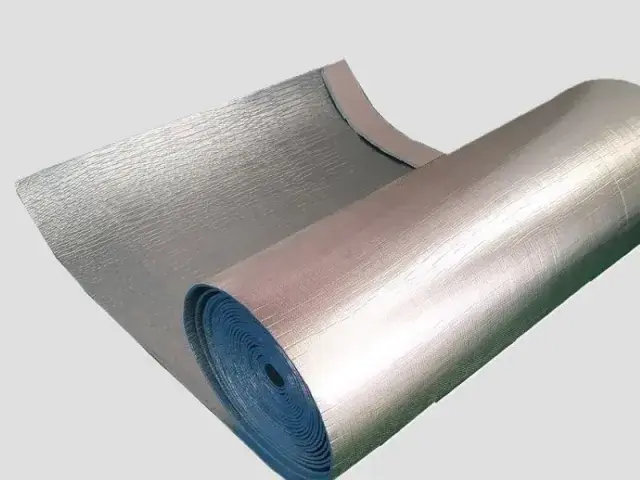
- Material: XPE, IXPE (polyethylene foam)
- Expansion ratio: 30 times (33 kg/m³)
- Width: 1 m, 1.2 m, 1.5 m (width can be customized)
- Thickness: 3 mm, 4 mm, 5 mm (thickness can be customized)
- Flame retardant grade: UL94 HF-1, GB8624-B1
Customization
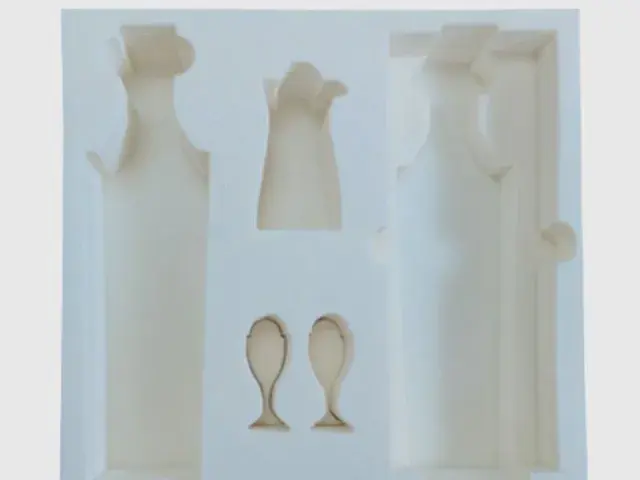
Made to order: density, thickness, colour and shape to your drawing. Die-cutting, CNC routing, lamination to film or fabric, slitting and adhesive coating all run in-house, so the part we quote is a finished part, not just a sheet. How a custom part is cut and routed explains what to send with the drawing.
Regular material: MOQ 1,000 m², lead time 15–20 days from order confirmation. Custom parts are quoted from the drawing. A4 samples are free, shipping included.
A tee is where a pipe run branches, and it is the point where insulation most often fails. A rigid pre-formed sleeve cannot follow the geometry, so the junction is either left bare or wrapped badly, and the thermal bridge at the tee undoes the performance of the whole run. Tee pipe insulation foam is a thin, conformable XPE sheet made to close that gap.
Features
- Conforms to complex geometry: at 3 mm to 5 mm the sheet folds and laps around a branch take-off, following the saddle where three pipe surfaces meet.
- Closed-cell thermal performance: the high-density closed-cell structure blocks air movement through the insulation, which is what delivers the insulation value.
- Water-resistant surface: absorbs very little water, so the junction stays effective in damp plant rooms and buried or condensation-prone runs.
- Acoustic benefit: the foam also damps the flow noise and vibration that concentrates at a junction.
- Weather resistance: holds up under temperature cycling on rooftop and external pipework. For long-term exposure to direct sun, specify a UV-stabilised grade or a protective facing.
- Flame retardant grades: UL94 HF-1 and GB8624-B1.
Applications
- Branch junctions on air-conditioning and chilled-water pipework
- Underfloor heating and hot and cold water distribution manifolds
- Chemical and pharmaceutical plant process piping
- Steam and chilled-water lines in industrial facilities
- Greenhouse and orchard irrigation headers
- Refrigerated transport and train carriage air-conditioning runs
Specifications for tee pipe insulation foam
A tee or a three-way joint is where a pipe wrap is hardest to fit, so the foam has to be soft enough to mould round the branch.
| Foam | Expansion | Apparent density | Single-layer thickness | Why this grade |
|---|---|---|---|---|
| XPE | 20–30× | 33.3–50 kg/m³ | 3–15 mm | Soft enough to wrap a branch without lifting at the crotch of the tee, while staying closed-cell against condensation. |
| IXPE | 25–35× | 28.6–40 kg/m³ | 0.1–15 mm | Finer cell and more conformable, for the tightest part of the joint. |
Base material specifications are on the XPE, IXPE and IXPP material pages; finished products are on the XPE foam and IXPE foam pages. Tell us the load, the space available and the service temperature and we will confirm the grade against your drawing.
Why Choose Bofeng Foam
We produce the foam at 30× foaming (33 kg/m³) in both XPE and IXPE, in 3 mm, 4 mm and 5 mm, in widths of 1 m, 1.2 m and 1.5 m, and to UL94 HF-1 and GB8624-B1. Supplying it in sheet rather than as a pre-formed fitting is deliberate: the installer cuts and laps the wrap to the junction in front of them, which gives a better seal than forcing a standard moulding onto a non-standard tee. Straight runs are covered with pipe insulation foam; the IXPE option is described on the IXPE foam page.
In-house conversion. The wrap is supplied in sheet so the installer can cut and lap at the tee. For repeat work we can slit it to the lap width, or die-cut a flat blank to your junction pattern, so the installer starts from a part that already follows the geometry. Regular sheet starts at 1,000 m²; cut-to-pattern parts are quoted from the joint drawing.
Which foam suits which line, and how thickness follows from the temperature difference, is covered in our pipe insulation guide.
Conclusion & Inquiry
Send the pipe diameters at the junction and the line temperature, and we will confirm the sheet thickness. Contact us for samples or a quotation.