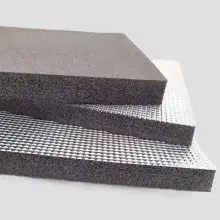
Thermal insulation foam is closed-cell polyethylene foam used to slow the movement of heat through a wall, pipe, duct, panel or battery pack. Bofeng Foam manufactures insulation foam in Zhuhai, China, in expansion ratios from 3× to 40× across XPE, IXPE and IXPP, with thermal conductivity from 0.095 W/(m·K) and the option of aluminium foil, non-woven or film facings laminated in house.
The reason closed-cell PE foam is so widely used for insulation is that the gas trapped in the cells does the insulating, and the polymer matrix keeps that gas exactly where it is. Nothing wicks, nothing soaks, and the performance you specify is the performance you get after installation.
What is thermal insulation foam?
Heat crosses an insulation layer in three ways: through the solid material, through the gas in the cells, and by radiation across the surfaces. Closed-cell foam attacks all three. Expanding the polyethylene 10 to 40 times replaces most of the solid polymer with gas, which is a far poorer conductor than the plastic around it. Sealing every cell stops the gas leaking out and stops moisture leaking in. A metallic foil facing then deals with the radiation component and adds a vapour barrier in the same layer.
Because the foam is cross-linked, it also keeps a stable thickness. An insulation layer that slowly compresses under a fixing, or sags between supports, loses the air gap that its performance depends on.
- Low thermal conductivity — from 0.095 W/(m·K) at the dense end of our range (3× grade, GB/T 10297 test method).
- Closed-cell barrier — water absorption of 0.2% or less by the GB/T 1034 method 4 test, so the insulation value does not fall away in damp service.
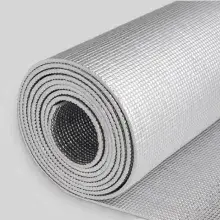
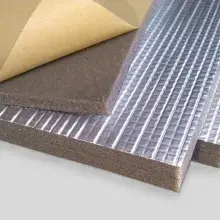
- Foil facing available — aluminium foil lamination adds a radiant barrier and a vapour barrier without a separate membrane.
- Heat resistance options — the heat-resistant grade holds to 110 °C with shrinkage of 8% or less; IXPP foam reaches 140 °C.
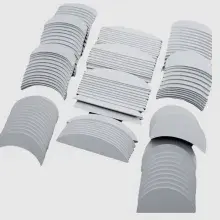
- Formable and flexible — the foam bends around pipes and duct radii, and can be die-cut into panels with exact dimensions.
Foam materials used for thermal insulation foam
Which material suits your insulation duty depends mainly on the temperature it has to withstand and the shape it has to wrap.
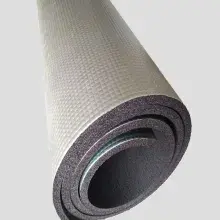
- XPE foam — chemically cross-linked polyethylene foam. Closed-cell, produced at 3–40× expansion with a density range of 26.8–300 kg/m³, in single layers of 3–15 mm. The general-purpose grade for most industrial work. View XPE foam →
- IXPE foam — radiation (electron-beam) cross-linked polyethylene foam. The finer cell structure allows single layers down to 0.1 mm with a smoother, more uniform surface. View IXPE foam →
- IXPP foam — radiation cross-linked polypropylene foam. Stiffer and more heat resistant than PE foam, with a maximum service temperature up to 140 °C. View IXPP foam →
| Material | Cross-linking | Expansion ratio | Width | Single-layer thickness | Heat-bonded multi-layer |
|---|---|---|---|---|---|
| XPE foam | Chemical (peroxide) | 3–40× | 500–2000 mm | 3–15 mm | 15–200 mm |
| IXPE foam | Radiation (electron beam) | 3–40× | 500–2000 mm | 0.1–15 mm | 15–200 mm |
| IXPP foam | Radiation (electron beam) | 5–25× | 500–1500 mm | 1–6 mm | 6–100 mm |
Use XPE for general building and equipment insulation where thickness and cost are the drivers, IXPE where the layer has to be thin — under a floor finish, behind a panel, inside a tight duct — and IXPP where the surface runs hot.
Choosing insulation foam: temperature, thickness and facing
Insulation is specified from three numbers: the temperature difference across the layer, the area to be covered, and the target surface temperature or condensation control requirement. From these we work out a thickness, then choose a facing.
- Condensation control on cold pipes and ducts — the closed-cell barrier plus a foil facing keeps the surface above dew point and stops dripping.
- Underfloor heating — the foam directs heat upwards into the floor build rather than down into the slab.
- Metal roof and wall build-ups — foil-faced foam adds a radiant barrier to a cavity that already has bulk insulation.
- Equipment and appliance insulation — thin IXPE layers fit the clearances inside a casing.
- Battery and power electronics — see our EV battery insulation foam page for the thermal management case.
Where the insulation also has to damp sound, the same closed-cell foam does both jobs; see soundproof foam for the acoustic side of the specification.
Thermal insulation foam products we manufacture
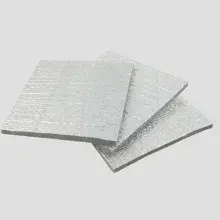
- Aluminium foil thermal insulation foam — foil-faced foam with a radiant and vapour barrier
- Underfloor heating insulation foam — reflective layer beneath a heated floor build-up
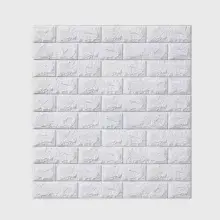
- Wall insulation foam — cavity and surface insulation for walls
- Roof insulation foam — foil-faced insulation for roof build-ups
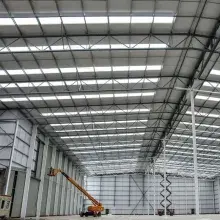
- Industrial plant roof insulation foam — insulation for large-span industrial roofs
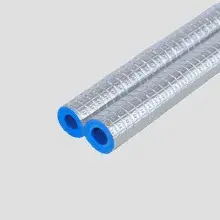
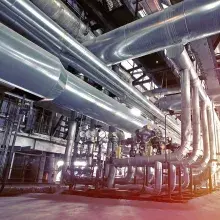
- Pipe insulation foam — wrap-around insulation for pipework
- Central air-conditioning duct insulation foam — duct insulation that also controls condensation
- Air conditioner insulation pipe foam — flexible insulation for refrigerant lines
- EV battery insulation foam — thermal management materials for battery packs
Typical applications
- Building envelope insulation — walls, roofs and ceilings
- Underfloor heating and floor build-ups
- HVAC ducting and refrigeration pipework
- Industrial plant and warehouse roofing
- Appliance and equipment casings
- EV battery packs and power electronics
Why choose Bofeng Foam?
Bofeng Foam is a direct factory manufacturer of cross-linked polyethylene foam in Zhuhai, China, with more than 10 years of experience in the foam industry. We run both chemical and radiation cross-linking in house, which means the material grade, density and surface finish can all be matched to your application rather than picked from a fixed catalogue.
- Both cross-linking routes in house — chemical (XPE) and electron-beam radiation (IXPE, IXPP), so you are not pushed towards one material for supply reasons.
- Wide grade coverage — expansion ratios from 3× to 40× and densities from 26.8 to 300 kg/m³, with single-layer thickness from 0.1 mm and heat-bonded multi-layer stock up to 200 mm.
- Converting under the same roof — die-cutting, CNC contouring, lamination, adhesive coating and slitting, so a finished part arrives instead of a roll.
- Functional grades when the application demands it — flame retardant (limiting oxygen index 27, meeting GB 8410 A0 and UL94 V2 requirements), heat resistant (110 °C, shrinkage ≤8%) and conductive (10³–10⁶ Ω) or anti-static (10⁶–10⁹ Ω).
- Engineering-led specification — send a drawing or a sample and our team will recommend the material, density, thickness and surface treatment that fit the load case, then confirm it against the GB/T test standards published on our material pages.
Request a quote for thermal insulation foam →
Because we laminate the foil layer ourselves, the facing and the foam are chosen together rather than bought as two parts and glued. That removes a bond line that could fail in a thermal cycle, and it keeps the vapour barrier continuous across the whole panel.
Thermal insulation foam FAQ
What is the thermal conductivity of your insulation foam?
The dense end of our range — the 3× grade — measures 0.095 W/(m·K) by the GB/T 10297 test method. Higher expansion ratios produce lighter foam with different conductivity characteristics; tell us the duty and we will confirm the figure for the specific ratio you need.
Is PE foam insulation suitable for cold pipes?
Yes, and it is a common use. The closed-cell structure means water absorption of 0.2% or less by the GB/T 1034 method 4 test, so the foam does not become a wet blanket, and a foil or film facing adds a vapour barrier that keeps the outer surface above dew point.
What is the maximum service temperature?
Standard XPE and IXPE foam is used at normal building and equipment temperatures. Our heat-resistant grade is rated to 110 °C with shrinkage of 8% or less, and IXPP foam extends the ceiling to 140 °C, which is the material to choose for hot surfaces, engine bays and near-boiler pipework.
Can the insulation foam be supplied with a foil facing?
Yes. We laminate aluminium foil, non-woven fabric and film facings in house, in single or double sided form. A foil facing adds a radiant barrier and a vapour barrier; a non-woven facing gives a bondable surface for adhesives and renders.
Does insulation foam also reduce noise?
It reduces structure-borne and impact noise as well as heat flow, because a flexible closed-cell layer decouples two rigid surfaces. Where airborne sound is the problem as well, the specification shifts towards the denser, more open acoustic treatments described under soundproof foam.
Related reading
See also: Aluminium foil thermal insulation foam · EV battery insulation foam · What is insulation foam made of · XPE foam insulation.