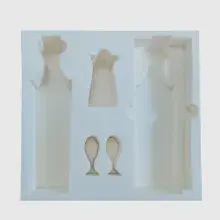
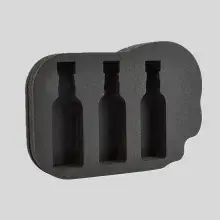
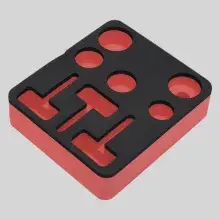
Cushioning foam is a closed-cell cross-linked polyethylene foam engineered to absorb impact energy and hold a product away from the shock and vibration it meets in transit, in a case, or on the body. Bofeng Foam manufactures cushioning foam in Zhuhai, China, in expansion ratios from 3× to 40× and densities from 26.8 to 300 kg/m³, so the cushion curve can be tuned to the weight and fragility of what it protects rather than taken from a single stock grade.
Cushioning is the single most common reason buyers come to cross-linked PE foam. The material is closed-cell, so it does not collapse under repeated loading the way an open-cell urethane does, and it keeps working across a wide temperature band without taking a permanent set.
What is cushioning foam?
A cushioning foam works by deforming under load and returning most of its thickness afterwards. That behaviour is set by two numbers: how far the material was expanded during manufacture, and how much of the original polymer remains in the cell walls. Expand a polyethylene billet 40 times and you get a very light, very soft foam for light products; expand it 3 times and you get a dense, firm sheet that will take a heavy point load without bottoming out.
Cross-linked PE foam is the usual choice where a cushion has to survive more than one impact, where it will be exposed to water or humidity, or where the cushion is also the visible part of the product.
- Closed-cell structure — individual cells are sealed, so the foam does not absorb water (≤0.2% by the GB/T 1034 method 4 test) and gives predictable support even in damp conditions.
- Repeated impact — compression set is low, so a cushion used many times does not progressively flatten.
- Wide density window — 26.8–300 kg/m³ covers everything from ultra-light void fill to dense protective pads.
- Tunable thickness — single layers from 0.1 mm (IXPE) or 3 mm (XPE), bonded up to 200 mm where a thick block is needed.
- Converting-friendly — die-cut, CNC-contoured, laminated or backed with adhesive without losing cushioning performance.
Foam materials used for cushioning foam
All three cross-linked materials we produce can be used for cushioning. The choice comes down to how thin the cushion has to be, and whether the part needs to stay soft at elevated temperature.
- XPE foam — chemically cross-linked polyethylene foam. Closed-cell, produced at 3–40× expansion with a density range of 26.8–300 kg/m³, in single layers of 3–15 mm. The general-purpose grade for most industrial work. View XPE foam →
- IXPE foam — radiation (electron-beam) cross-linked polyethylene foam. The finer cell structure allows single layers down to 0.1 mm with a smoother, more uniform surface. View IXPE foam →
- IXPP foam — radiation cross-linked polypropylene foam. Stiffer and more heat resistant than PE foam, with a maximum service temperature up to 140 °C. View IXPP foam →
| Material | Cross-linking | Expansion ratio | Width | Single-layer thickness | Heat-bonded multi-layer |
|---|---|---|---|---|---|
| XPE foam | Chemical (peroxide) | 3–40× | 500–2000 mm | 3–15 mm | 15–200 mm |
| IXPE foam | Radiation (electron beam) | 3–40× | 500–2000 mm | 0.1–15 mm | 15–200 mm |
| IXPP foam | Radiation (electron beam) | 5–25× | 500–1500 mm | 1–6 mm | 6–100 mm |
As a working rule: XPE for general cushioning and protective pads, IXPE where the cushion is under a few millimetres thick or has to look clean, and IXPP where the part sits next to heat or needs more stiffness than PE foam gives.
Cushioning performance and how to specify it
Cushioning is not a single number. When we quote a cushion we work from four inputs: the product mass, the drop height it must survive, the contact area available for the foam, and the number of impacts it has to take. From those we recommend an expansion ratio (which fixes the density) and a thickness.
- Light, frequent impacts — higher expansion ratio (lower density), so the foam deflects easily and returns.
- Heavy or pointed loads — lower expansion ratio (higher density), so the cushion resists bottoming out and the load spreads sideways.
- Repeated handling — add thickness rather than density; a thicker softer cushion usually outlives a thin hard one.
- Thin profiles — IXPE down to 0.1 mm single layer, which still gives useful cushioning in gaskets and precision packaging.
Where a cushion also functions as a divider or a locating insert, we die-cut or CNC the contour so the part locates the product and absorbs the shock in the same operation.
Cushioning foam products we manufacture
- Custom foam inserts — die-cut and CNC-contoured cushions that also locate the product
- Packaging foam — protective packaging built around a cushion curve
- Yoga mat — body-contact cushioning that has to recover after every use
- Sports protective foam — impact pads, guards and padding
- Luggage liner foam — thin cushioning laminated into a bag interior
- Athletic insole foam — repeated-load cushioning underfoot
- Foam roller — high-cycle cushioning that must keep its shape
Typical applications
- Protective packaging for electronics, instruments and glass
- Cases, tool boxes and flight cases with cut foam interiors
- Sports and body-contact padding — mats, guards, insoles
- Luggage, backpack and footwear linings
- Automotive interior padding and anti-vibration layers
- Medical and rehabilitation positioning cushions
Why choose Bofeng Foam?
Bofeng Foam is a direct factory manufacturer of cross-linked polyethylene foam in Zhuhai, China, with more than 10 years of experience in the foam industry. We run both chemical and radiation cross-linking in house, which means the material grade, density and surface finish can all be matched to your application rather than picked from a fixed catalogue.
- Both cross-linking routes in house — chemical (XPE) and electron-beam radiation (IXPE, IXPP), so you are not pushed towards one material for supply reasons.
- Wide grade coverage — expansion ratios from 3× to 40× and densities from 26.8 to 300 kg/m³, with single-layer thickness from 0.1 mm and heat-bonded multi-layer stock up to 200 mm.
- Converting under the same roof — die-cutting, CNC contouring, lamination, adhesive coating and slitting, so a finished part arrives instead of a roll.
- Functional grades when the application demands it — flame retardant (limiting oxygen index 27, meeting GB 8410 A0 and UL94 V2 requirements), heat resistant (110 °C, shrinkage ≤8%) and conductive (10³–10⁶ Ω) or anti-static (10⁶–10⁹ Ω).
- Engineering-led specification — send a drawing or a sample and our team will recommend the material, density, thickness and surface treatment that fit the load case, then confirm it against the GB/T test standards published on our material pages.
Request a quote for cushioning foam →
Because the cushion curve is set by expansion ratio rather than by a fixed catalogue grade, we can usually meet a drop-test requirement by changing the ratio and the thickness instead of adding more material. Send us the product weight, the drop height and the space you have, and we will come back with a ratio and a thickness to test.
Cushioning foam FAQ
What density of cushioning foam should I choose?
Start from the load. Light products up to a few hundred grams are normally cushioned with a high expansion ratio in the 25–40× range; heavier or pointed loads move towards 10–20×; dense protective pads and machine feet sit at the low end, 3–8×. The density figure is a consequence of the ratio — a 30× foam lands near the light end of our 26.8–300 kg/m³ range.
Is cross-linked PE foam better than polyurethane for cushioning?
For repeated impacts and for damp or outdoor conditions, yes. Cross-linked PE foam is closed-cell and has low compression set, so it keeps its thickness over many cycles and does not take on water. Open-cell polyurethane is softer at the same density and is often cheaper, but it fatigues faster and absorbs moisture.
How thick does a cushioning layer need to be?
Thickness and ratio work together. As a starting point the foam should be able to deflect by roughly half its thickness without the product touching the outer wall. That is why thin applications usually need a lower ratio (higher density) and thicker applications can use a high ratio. We confirm the final figure against the load case you give us.
Can cushioning foam be cut to a complex shape?
Yes. We die-cut, CNC-contour, slit and laminate, so the cushion can be supplied as a flat sheet, a shaped pad, or a multi-layer insert that combines a soft inner layer with a firmer outer one. Adhesive backing is available where the foam has to stay in place during assembly.
Does cushioning foam work at low or high temperature?
PE foam keeps useful cushioning well below zero and is stable through normal indoor and vehicle-cabin temperatures. Where the part sits close to a heat source, IXPP foam extends the service ceiling to 140 °C and the heat-resistant grade holds to 110 °C with shrinkage of 8% or less.
Related reading
See also: How to choose foam density and thickness · Closed cell vs open cell foam · Custom foam inserts: packaging design guide · XPE foam density guide.