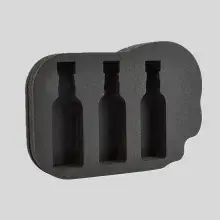
Fire retardant foam is cross-linked polyethylene foam modified so that it resists ignition and does not sustain a flame once the ignition source is removed. Bofeng Foam manufactures flame-retardant foam in Zhuhai, China, in a grade with a limiting oxygen index of 27 that meets the requirements of GB 8410 A0 and UL94 V2.
Flame-retardant foam is specified where a product has to pass a flammability requirement — a vehicle interior, a building material, an appliance or a piece of equipment inside an enclosure. The requirement is normally written into a standard, and the job of the material is to satisfy it without giving up the cushioning or sealing function the foam is there for.
What is fire retardant foam?
Polyethylene burns readily on its own. Flame retardants change that by interfering with the chemistry of combustion — either in the gas phase, where they interrupt the radical reactions that keep a flame going, or in the condensed phase, where they promote the formation of a char layer that insulates the material underneath.
The number that describes how well this works is the limiting oxygen index (LOI): the minimum concentration of oxygen in the surrounding atmosphere that will support combustion of the material. Ordinary air is about 21%. A material with an LOI above 21% will not keep burning in air once the ignition source is taken away. Our flame-retardant grade has an LOI of 27, which gives a useful margin above that threshold.
Two standard tests are used to demonstrate compliance in practice, and both are relevant to different industries: GB 8410 A0, the Chinese automotive interior material standard, and UL94 V2, the plastics flammability classification widely referenced in electronics and appliances.
- Limiting oxygen index 27 — well above the 21% of ordinary air, so the foam does not sustain combustion once the ignition source is removed.
- GB 8410 A0 — meets the requirements of the Chinese automotive interior materials flammability standard.
- UL94 V2 — meets the vertical-burn classification referenced by electronics and appliance specifications.
- Foam performance retained — the retardant is compounded into the material, so the foam still cushions, seals and insulates.
- Available across the range — the grade is produced on the XPE and IXPE base materials, in the same thicknesses.
Foam materials used for fire retardant foam
The flame-retardant grade is produced on the same cross-linked base materials as our standard foam, so the thickness, width and converting options are unchanged.
- XPE foam — chemically cross-linked polyethylene foam. Closed-cell, produced at 3–40× expansion with a density range of 26.8–300 kg/m³, in single layers of 3–15 mm. The general-purpose grade for most industrial work. View XPE foam →
- IXPE foam — radiation (electron-beam) cross-linked polyethylene foam. The finer cell structure allows single layers down to 0.1 mm with a smoother, more uniform surface. View IXPE foam →
- IXPP foam — radiation cross-linked polypropylene foam. Stiffer and more heat resistant than PE foam, with a maximum service temperature up to 140 °C. View IXPP foam →
| Material | Cross-linking | Expansion ratio | Width | Single-layer thickness | Heat-bonded multi-layer |
|---|---|---|---|---|---|
| XPE foam | Chemical (peroxide) | 3–40× | 500–2000 mm | 3–15 mm | 15–200 mm |
| IXPE foam | Radiation (electron beam) | 3–40× | 500–2000 mm | 0.1–15 mm | 15–200 mm |
| IXPP foam | Radiation (electron beam) | 5–25× | 500–1500 mm | 1–6 mm | 6–100 mm |
For automotive interior and under-bonnet work, the grade is normally supplied on XPE or on the finer-celled IXPE where the part has to be thin. Where the component also runs hot, IXPP extends the service ceiling to 140 °C.
Flame retardant grades and what the standards mean
It is worth being precise about what a flame-retardant foam does and does not do, because the terms are used loosely in the market.
- Fire retardant means the material resists ignition and does not sustain a flame. It does not mean fireproof, and it does not mean the material will not burn if held in a flame.
- LOI 27 is a material property measured on a test specimen. It describes how the material behaves in a controlled atmosphere, not how a finished assembly will behave.
- GB 8410 A0 is a component-level test for automotive interior materials and is the reference used by Chinese vehicle OEMs; A0 is the most demanding grade.
- UL94 V2 is a vertical burn classification for plastics. It is a material classification, not a certification of your finished product.
If your project specifies a standard, send us the clause and the test method and we will confirm what our grade can demonstrate against it. We hold ISO 9001 and ISO 14001 for our management systems; for the functional grades we state standard compliance. For background on how these schemes differ, see our certifications page.
Fire retardant foam products we manufacture
- Automotive foam — interior and under-bonnet foam for vehicles
- Automotive tape foam — flame-retardant tape for automotive assembly
- Acoustic foam — flame-retardant acoustic layers for equipment
- EV battery insulation foam — insulation materials for battery packs
- Laminated foam — flame-retardant foam bonded to foil or fabric facings
- Custom foam inserts — die-cut inserts in a flame-retardant grade
Typical applications
- Automotive interior trim, headliners and under-carpet layers
- Under-bonnet and engine-bay insulation
- Appliance and equipment enclosures
- Building and construction foam where a flammability class is specified
- EV battery pack insulation and padding
- Acoustic and thermal layers inside equipment cabinets
Why choose Bofeng Foam?
Bofeng Foam is a direct factory manufacturer of cross-linked polyethylene foam in Zhuhai, China, with more than 10 years of experience in the foam industry. We run both chemical and radiation cross-linking in house, which means the material grade, density and surface finish can all be matched to your application rather than picked from a fixed catalogue.
- Both cross-linking routes in house — chemical (XPE) and electron-beam radiation (IXPE, IXPP), so you are not pushed towards one material for supply reasons.
- Wide grade coverage — expansion ratios from 3× to 40× and densities from 26.8 to 300 kg/m³, with single-layer thickness from 0.1 mm and heat-bonded multi-layer stock up to 200 mm.
- Converting under the same roof — die-cutting, CNC contouring, lamination, adhesive coating and slitting, so a finished part arrives instead of a roll.
- Functional grades when the application demands it — flame retardant (limiting oxygen index 27, meeting GB 8410 A0 and UL94 V2 requirements), heat resistant (110 °C, shrinkage ≤8%) and conductive (10³–10⁶ Ω) or anti-static (10⁶–10⁹ Ω).
- Engineering-led specification — send a drawing or a sample and our team will recommend the material, density, thickness and surface treatment that fit the load case, then confirm it against the GB/T test standards published on our material pages.
Request a quote for fire retardant foam →
Fire performance is normally one requirement inside a longer specification, and it is easy to satisfy it at the cost of everything else. Ask us to quote the flame-retardant grade against the rest of your requirement — density, thickness, facing and cut — so the material that passes the burn test is also the material the application needs.
Fire retardant foam FAQ
Is fire retardant foam the same as fireproof foam?
No, and the distinction matters. Fire retardant means the foam resists ignition and does not sustain a flame once the ignition source is removed — which is what our LOI 27 grade does. Fireproof would mean it cannot burn at all, which is not a property of polyethylene foam. No foam should be specified as a fire barrier on its own; it is one layer in an assembly that has to pass a test as a whole.
What is the limiting oxygen index and what does LOI 27 mean?
The limiting oxygen index is the minimum percentage of oxygen in the surrounding atmosphere that will support combustion of the material. Ordinary air is about 21% oxygen, so a material with an LOI of 27 will not keep burning in air once the ignition source is removed. It is a measured material property and gives a useful margin above the ambient figure.
Which standards does your flame retardant foam meet?
Our flame-retardant grade meets the requirements of GB 8410 A0, the Chinese automotive interior materials flammability standard, and UL94 V2, the vertical-burn classification widely referenced in electronics and appliances. These are statements of standard compliance for the material grade. If your project references a specific clause or test method, send it to us and we will confirm what the grade can demonstrate.
Does adding flame retardant change the foam properties?
The retardant is compounded into the material, so the foam still cushions, seals, insulates and damps as the standard grade does, and it is produced across the same XPE and IXPE base materials in the same thickness range. Where the application has tight density or hardness targets, tell us and we will confirm the specific ratio.
Can flame retardant foam be laminated or die-cut?
Yes. It is die-cut, CNC-contoured, laminated to foil, non-woven and film facings, and coated with adhesive in the same way as our standard grades. This matters where the fire rating applies to a finished part rather than to a sheet — a faced and cut insert is what actually goes into the assembly.
Related reading
See also: Automotive sound deadening foam buyers guide · EV battery insulation foam · XPE vs IXPE vs IXPP foam guide.