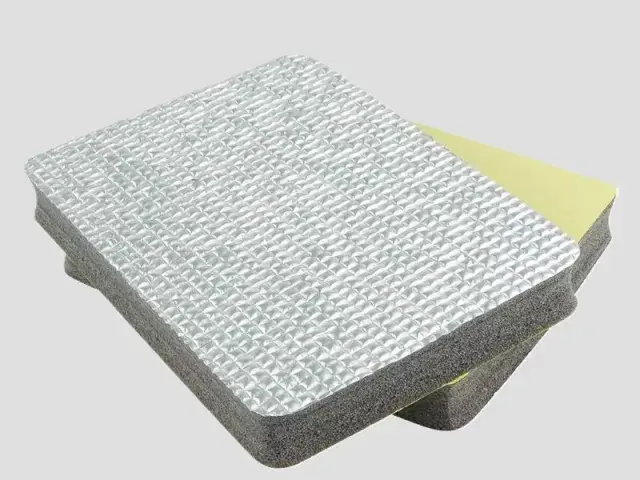

- Material: XPE foam, IXPE foam
- Expansion ratio: 25 times (40 kg/m³), 30 times (33 kg/m³)
- Thickness: 50 mm, 80 mm, 100 mm (thickness can be customized)
- Colour: black, white (colour can be customized)
- Flame retardant grade: UL94 HF-1
Customization
Made to order: density, thickness, colour and shape to your drawing. Die-cutting, CNC routing, lamination to film or fabric, slitting and adhesive coating all run in-house, so the part we quote is a finished part, not just a sheet. How a custom part is cut and routed explains what to send with the drawing.
Regular material: MOQ 1,000 m², lead time 15–20 days from order confirmation. Custom parts are quoted from the drawing. A4 samples are free, shipping included.
A wine bottle is heavy, rigid and unforgiving. Drop the case and the impact travels straight through the glass, and the failure usually starts at the neck or at the base rim rather than in the middle of the bottle. A foam insert works by spreading that load across a larger area of the bottle and by extending the time over which the energy is absorbed, so the peak force the glass sees is lower.
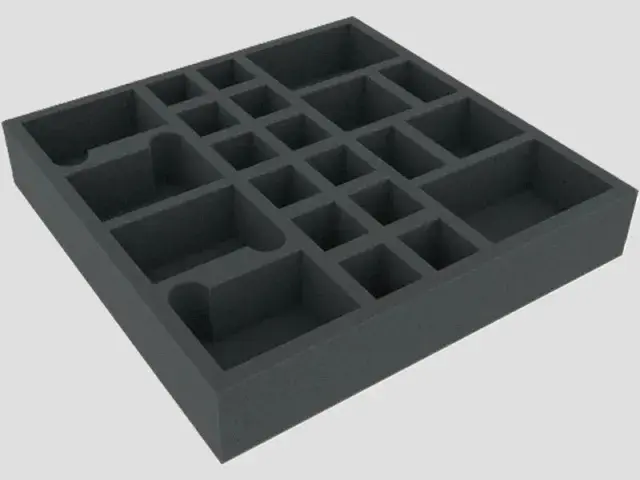
This page is about the insert you specify: how a bottle should be supported, how density and thickness decide what the part can absorb, how the cavity is cut to your bottle, and what an insert cannot do for a shipment. It covers XPE and IXPE sheet, cut and routed into fitted beds, cradles, base pads and corner blocks.
What the Insert Has to Do
- Support the bottle, not just cushion it. A bottle resting on one contact point concentrates the whole impact there; the liner's job is to share it between your bottle's base, shoulder and neck.
- Absorb a drop. Closed-cell foam crushes progressively, so the deceleration is spread over a distance instead of arriving as a spike.
- Stop movement in transit. Vibration over a long freight route wears through a loose fit; the cavity has to hold your bottle without a gap that lets it work free.
- Survive stacking. Cases are stacked in a container for weeks. The foam has to resist compression set so the bottle does not come loose in the middle of the journey.
- Protect what the customer sees. Labels and foils scuff against a hard edge. A closed-cell foam face, cut cleanly, gives the bottle a surface that will not abrade it.
An insert that only does the second item is a cushion, not a pack. Most field failures come from the third and fourth: a cavity that was a millimetre too generous, or a foam that took a set under a stack and stopped holding.
Where the Bottle Is Supported
| Support point | What it protects against | How it is cut |
|---|---|---|
| Base | Vertical drop, stacking load, base-rim chipping | Recessed pocket or a base pad under the bottle |
| Body and shoulder | Side impact, movement inside the case | Fitted cavity following the bottle profile |
| Neck and closure | Leverage at the neck, cap damage, tearing of the capsule | Narrow neck slot or a separate top pad |
A single recessed base pocket is the cheapest insert and the one that fails most often, because the bottle can still rock at the shoulder. A two-piece set — a base bed with a fitted cavity and a lid pad that closes over the neck — costs more foam and holds far better. The case, the carton and the way the boxes are stacked all change the answer, which is why the drawing should show the case, not just the bottle.
Insert Formats
- Base bed with a fitted cavity. The bottle sits in a die-cut recess; a lid pad closes over it. The most common format for a single bottle in a rigid box.
- Two-part clamshell. A base and a lid cut from the same sheet, hinged or separate, for a bottle that has to be presented on opening.
- Corner blocks and end caps. Foam at the corners of a carton, with the bottle held in a pulp or board cradle. Lower foam cost, less support at the shoulder.
- Interleaving layers. Thin IXPE sheet between bottles in a multi-bottle case, where a full cavity in every position would be too much material.
- Base pads only. A flat pad under the base of each bottle inside a carton that already has dividers. The minimum intervention, and enough only when the carton itself is well designed.
The format should follow the failure mode you are protecting against. A parcel-network shipment needs a closed, drop-tested carton and an insert that holds the bottle through it. A gift box that travels in a pallet is mostly a presentation problem with a stacking requirement.
Density, Thickness and the Load Path
Two numbers decide how much energy the insert can absorb: the foam's density and the thickness of foam between the bottle and the outside of the pack. A denser grade absorbs more energy per unit of crush but transmits a higher force before it starts to give; a lighter grade is gentler and bottoms out sooner.
The XPE grades used for inserts sit between 50 and 100 kg/m³ at 10–20× expansion, which is the band where a die-cut cavity keeps its shape and does not fatigue over a repeating transit cycle. IXPE in the 20–30× range, at 33.3–50 kg/m³, is used for the thinner interleaving layers where a firm sheet would not close around the part.
Thickness is measured as the foam between the bottle and the outside face, not as the sheet gauge on the drawing. A 50 mm section that has a 40 mm cavity in it leaves 10 mm of working foam, and that is the number the drop energy sees. Heat-bonded multilayer runs from 15 mm to 200 mm, so a section can be built to the depth the cavity needs. If your carton already has 20 mm of clearance on every side, adding a 100 mm block does not automatically improve the result — it can make the pack too stiff and pass the impact straight through.
Cut, Score and Fit
Inserts are die-cut for volume and CNC-routed for prototypes and short runs. Both cut closed-cell foam cleanly, and both depend on the same three details.
- The cavity fit. A bottle that drops into the cavity without touching the walls is not held; a cavity that has to be forced is a handling problem on the packing line. The usable interference comes from the foam's own compressibility, and it depends on the grade.
- The cut edge. A clean vertical edge holds the bottle; a ragged edge crushes and leaves a gap that widens with each cycle.
- The layer stack. Where one thickness cannot meet both the cavity depth and the outside dimension of the box, the part is laminated from two grades rather than cut from one. Heat-bonded multilayer runs from 15 mm to 200 mm.
Send the bottle drawing with the closure fitted, the case internal dimensions, the number of bottles and the packed weight. The cut layout follows from those four numbers, and a sample cut before the die is made will show whether the fit is right.
Moisture, Labels and Long Storage
Wine is stored in damp cellars and shipped through cold chains, so the insert has to tolerate moisture without swelling or softening. XPE and IXPE are closed-cell foams; water absorption in the grades used for inserts measures 0.2% or less to 0.3% or less after 22 hours at 23 °C by GB/T 1034 method 4, and the sheet does not soften when it is damp.
For the label, the relevant property is the surface. A closed-cell foam cut with a sharp die gives a smooth face that will not abrade paper or foil, and it holds no grit. In long-term storage the risk is pressure rather than friction: a bottle pressed into a cavity that is too tight can mark the label over months, so the fit should be checked on a packed case that has sat under load, not on a fresh sample.
Specifications We Can Supply
| Property | XPE | IXPE |
|---|---|---|
| Expansion ratio | 10–20× | 20–30× |
| Apparent density | 50–100 kg/m³ | 33.3–50 kg/m³ |
| Single-layer thickness | 3–15 mm | 0.1–15 mm |
| Heat-bonded multilayer | 15–200 mm | 15–200 mm |
| Standard sections for cavity work | Heat-bonded multilayer from 15 mm to 200 mm covers a shallow pad up to a deep block | |
| Water absorption | 0.2% or less to 0.4% or less, GB/T 1034 method 4 | |
| Compression set, 23 °C / 22 h | 5% or less to 8% or less (GB/T 6669) | 8% or less to 10% or less |
| Colour | Black and white as standard; further colours on request | |
| Flame-retardant grades | LOI 27, GB 8410 A0, UL94 V2; UL94 HF-1 also available | |
| Processing | Die-cutting, CNC routing, lamination, pressure-sensitive adhesive backing | |
What an Insert Cannot Do For You
- It cannot certify the pack. A drop-test result belongs to the complete pack — carton, insert, dividers, closure and the way it is palletised — not to the foam inside it. We do not issue an ISTA or a carrier drop-test certificate for a pack we did not build and test.
- It cannot rescue an undersized carton. If there is 5 mm between the bottle and the carton wall, no grade of foam turns that into a drop-resistant pack. The clearance has to exist before the insert is designed.
- It is not supplied for direct food contact. The insert touches the outside of a sealed bottle, which is not a food-contact surface. We do not supply foam certified for direct contact with food or drink, so a liner that touches the wine itself, the inside of the closure or a food product is outside what this material is offered for.
- No guarantee against every scuff. The foam face is smooth and will not abrade a label in normal handling, but a bottle forced into a tight cavity, or a pack that travels with a hard object against the label, can still mark it.
- Not a structural component. The insert holds and cushions. It does not stiffen the carton, replace a divider or carry the stacking load of a pallet on its own.
That list is short on purpose. Everything on it is something a customer has asked us to certify at some point, and every one of those requests was answered in writing rather than in the pack.
Ordering, MOQ, Lead Time and Sample
- MOQ. 1,000 m² is the minimum for standard sheet. A die-cut insert is priced from the drawing and the yearly quantity, because the cut layout and the die move the cost harder than the foam does.
- Lead time. Allow 15–20 days after the order is confirmed for standard material; a first-off die-cut part additionally covers tooling and sample sign-off.
- Sample. The first step is a free sample: an A4 sheet of the chosen grade, sent with the freight paid, so you can hold the sheet before the die is cut. A cut sample of the actual cavity is priced with the tooling.
- What to send. The bottle drawing with the closure fitted, the case internal dimensions, the number of bottles per case, the packed weight, the distribution channel and the flame requirement if there is one.
FAQ
Which grade should I choose for a single bottle in a gift box?
XPE at 10–20×, in the 50–100 kg/m³ band, is the usual starting point: firm enough to hold a die-cut cavity and stable enough not to fatigue in transit. A lighter IXPE grade is used for the lid pad, where the foam only has to close the gap.
How thick should the insert be?
Thick enough that the foam between the bottle and the carton wall absorbs the drop, and thin enough that the pack still closes. Measure the working thickness — the foam left outside the cavity — rather than the sheet gauge.
Can the insert be recycled with the carton?
PE foam is a separate material stream from paperboard and has to be separated before recycling. Whether a given municipal or commercial stream accepts it depends on the local scheme, so the answer is not ours to give for your market.
Do you supply the carton as well?
No. The insert is the foam part. Your carton, the printing and the assembly are specified by the packaging designer, and the foam is cut to the internal dimensions on the drawing.
Can the insert be printed or branded?
Embossing and printing on the foam surface are available. Send the artwork with the drawing, because the print area and the cavity layout have to be designed together.
Related Applications
Wine is one case of a wider problem: a heavy, fragile, high-value object that has to survive a parcel network and still look untouched when the box is opened. Glass packaging foam applies the same load-spreading logic to flat fragile goods, ceramic packaging inserts to hollow shapes that fail at the rim, and electronic product inserts to parts where a conductive grade may also be needed. The wider range is on packaging foam, and the two numbers an insert is designed around — cut-through and retained bottom — are explained in our custom foam insert design guide. Material data is on the XPE, IXPE and IXPP pages, and finished sheet ranges on XPE foam and IXPE foam. Send the bottle and case dimensions and a cut layout comes back with the quote.