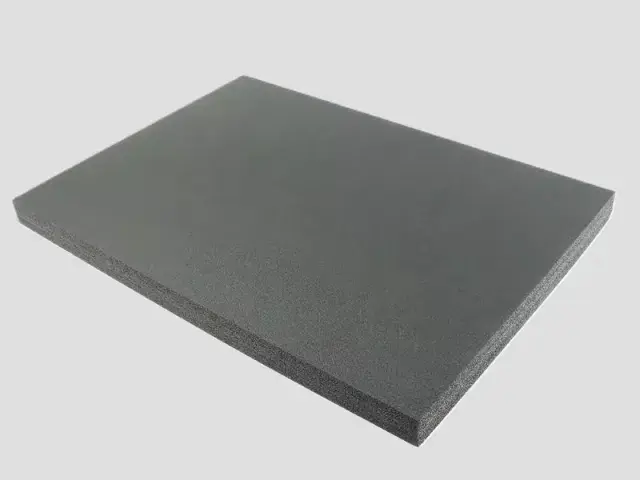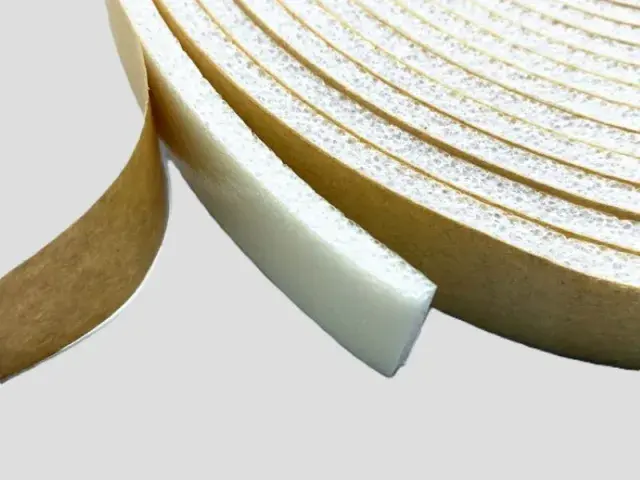

- Material: XPE (chemical cross-linked PE) or IXPE (irradiation cross-linked PE), closed cell
- Expansion ratio: 3–40×; lower ratio gives a denser, firmer pad
- Apparent density: 26.8–300 kg/m³, grade-dependent
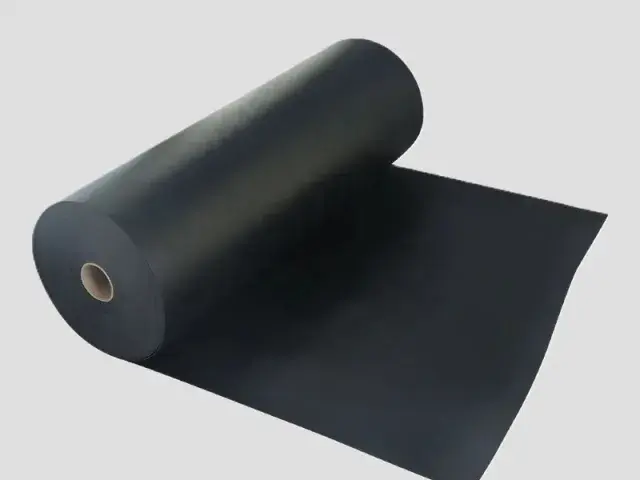
- Sheet width: 500–2000 mm; cut to pad size
- Thickness: XPE single layer 3–15 mm, IXPE single layer 0.1–15 mm; laminated 15–200 mm
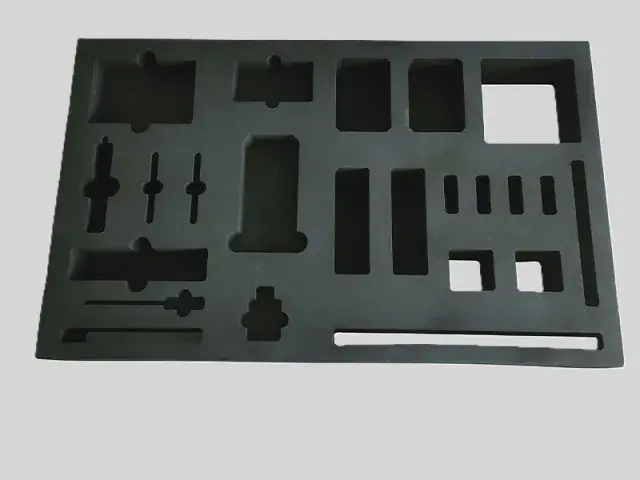
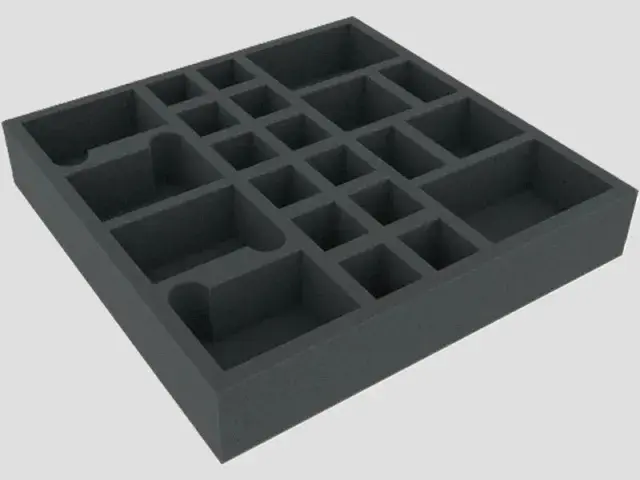
- Forms: flat pad, interlayer sheet, edge strip, corner cap, die-cut outline
- Water absorption: 0.2% or less to 0.4% or less (GB/T 1034, method 4)
- Colour: black, white, grey, custom
- Conversion: die-cutting, CNC milling, lamination, slitting, adhesive backing
Customization
Made to order: density, thickness, colour and shape to your drawing. Die-cutting, CNC routing, lamination to film or fabric, slitting and adhesive coating all run in-house, so the part we quote is a finished part, not just a sheet. How a custom part is cut and routed explains what to send with the drawing.
Regular material: MOQ 1,000 m², lead time 15–20 days from order confirmation. Custom parts are quoted from the drawing. A4 samples are free, shipping included.
A PV module cushion pad is a handling and transport cushion. It goes between modules in a stack, under a frame edge, or over a junction box during packing, shipping and installation handling. It is not a thermal-management pad, it is not part of the module construction, and it is not an electrical insulation component.
We supply the foam: closed-cell XPE or IXPE sheet, cut into interlayer sheets, edge strips, corner caps and die-cut pads. The module design, the packaging qualification and the installation method belong to the module maker and the installer.
Where the Foam Is Used
- Interlayer separation. A sheet between modules in a transport stack, so glass and frame do not rub.
- Edge and corner protection. A strip or cap on the frame edge where the module rests against a crate or rack.
- Junction-box cushioning. A pad over the junction box so the box does not take the stack load.
- Installation handling. A temporary pad under a module while it is set on a rail or a work surface.
- Returnable racks. A liner on the contact faces of a reusable transport rack.
Forms We Supply
| Format | Description | Typical use | Note |
|---|---|---|---|
| Interlayer sheet | Flat sheet cut to module footprint | Stacking modules for transport | Thickness sets the gap between frames |
| Edge strip | Narrow strip or L profile | Frame edges against a crate or rack | Keep the strip on the frame, not on the glass face |
| Corner cap | Three-sided cap | Module corners in a crate | Fit controls whether it stays on |
| Junction-box pad | Small die-cut pad | Protecting the junction box in a stack | Check the pad thickness against the box height |
| Die-cut outline | Cut to the module or frame outline | Automated packing lines | Send the drawing; a new die includes sample approval |
Material Choice: XPE or IXPE
| Material | Thickness | Why it fits | Limit |
|---|---|---|---|
| XPE | 3–15 mm single layer; 15–200 mm laminated | Tough, cost-effective, resists tearing, good for reusable racks | Rougher surface; thicker sections need lamination |
| IXPE | 0.1–15 mm single layer; 15–200 mm laminated | Thin, smooth, low dust; clean contact with glass and frame | Higher cost; very thin pads offer little cushioning |
For a single-trip stack, XPE is usually enough and costs less. For a reusable rack, or where the pad touches a visible glass face, IXPE is the better choice because it is smooth and sheds less dust. Neither material is a permanent part of the module.
Thickness and Density
Thickness sets the clearance between stacked modules and the amount the pad can deflect. Too thin and the frames touch; too thick and the stack becomes unstable or the crate is overfilled. Density sets stiffness: a denser pad holds its thickness under stack load, a lighter pad conforms but compresses further.
Our range runs from 26.8 to 300 kg/m³ depending on the expansion ratio. For interlayer sheets under a tall stack, choose a grade that does not take a permanent set under the stack weight; for edge protection, a medium density is usually enough. Tell us the stack height, the module weight and the frame profile, and we will quote a thickness and density to review against the packing design.
Outdoor Exposure
These pads are intended for packing, transport and installation handling. They are not designed as a permanent outdoor component of a PV array. If a pad will be left exposed to sunlight for a long period, confirm the grade and the exposure with us first; we do not publish a UV service-life figure, and we do not recommend using the foam as a permanent weather-exposed part without a specific confirmation.
What the Foam Is Not
- Not a thermal-management pad. The foam does not conduct heat away from a module and is not a replacement for a thermal interface material.
- Not electrical insulation. We do not rate the foam for dielectric strength, and it must not be used as the insulation between a live conductor and a person or a grounded surface.
- Not a structural spacer. The foam does not carry mounting load and does not replace a rail, a clamp or a frame.
- Not part of the module. The foam is not laminated into the module and is not covered by the module maker’s qualification.
What We Do Not Claim
- No IEC module certification. We do not claim IEC 61215, IEC 61730 or any other module standard for the foam or for a packed module.
- No PID or reliability claim. We do not claim potential-induced degradation resistance, and we do not support a module reliability or warranty statement.
- No dielectric rating. We do not publish a breakdown voltage or a comparative tracking index for the foam.
- No UV service life. We do not publish an outdoor weathering or UV life figure.
- No validated pack. We supply the cushion, not a qualified transport pack. Pack validation belongs to the module maker.
- No food-contact suitability. Our standard foam is not supplied as a food-contact material.
Specifications We Can Supply
| Property | XPE | IXPE |
|---|---|---|
| Expansion ratio | 3–40× | 3–40× |
| Apparent density | 26.8–300 kg/m³, grade-dependent | |
| Single-layer thickness | 3–15 mm | 0.1–15 mm |
| Laminated sections | 15–200 mm | 15–200 mm |
| Sheet width | 500–2000 mm; cut to pad size | |
| Water absorption | 0.2% or less to 0.4% or less, GB/T 1034 method 4 | |
| Compression set | 2% or less to 11% or less, GB/T 6669 | |
| Thermal conductivity | 0.040–0.095 W/(m·K), grade-dependent | |
Ordering, MOQ, Lead Time and Sample
- MOQ: 1,000 m² for standard sheet. Die-cut pads are quoted against the drawing and the annual volume.
- Lead time: 15–20 days from order confirmation for standard material; a new die includes sample approval and tooling.
- Sample: an A4 piece is free; we pay the freight.
- What to send: the module or frame drawing, the stack height, the module weight, the pad position and the annual quantity.
FAQ
Can the foam be left in the module permanently?
These pads are for packing, transport and installation handling. We do not recommend leaving them as a permanent weather-exposed part without a specific confirmation of the grade and the exposure. They are not a module component.
Is the foam electrically insulating?
We do not rate the foam for dielectric strength. It must not be used as the insulation between a live conductor and a person or a grounded surface. Electrical insulation in a PV system is a design requirement with its own components and standards.
Will the foam mark the glass?
A smooth IXPE pad sheds less dust than a rougher XPE sheet and is the better choice against a visible glass face. Whatever the material, keep the pad clean and dry, and test on a sample before a full pack.
Can the foam take the stack load?
It cushions the stack; it does not carry the mounting load. Under a tall stack, choose a grade that does not take a permanent set under the stack weight, and check the stack design. Tell us the stack height and module weight and we will quote a density.
Can you match the packing-line size?
Yes. Pads and sheets are cut to the drawing, including die-cut outlines for automated lines. Send the drawing or a sample and the annual quantity.
Related Applications
PV tape foam · EV battery cell spacer foam · New energy foam · Electronic product packaging foam · Custom foam inserts · XPE and IXPE materials